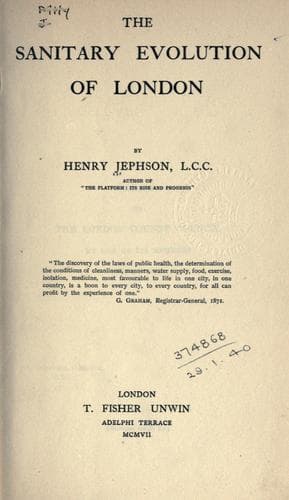
The Sanitary Evolution of LondonJephson, Henry (Henry Lorenzo)
History
The Sanitary Evolution of London
Jephson, Henry (Henry Lorenzo)
Public health -- England -- London
"... When we come to those occupying only one room each, and
remembering that in many of these rooms the closet, the water-butt, the
water supply, and everything else was contained in the room itself, and
that there was no provision for manure, ashes, or refuse of any kind,
you can easily conceive what a wretched state of things that presents.
On the average there were 2·80 persons per room permanently occupying
them. So it cannot be wondered at an outbreak of the zymotic disease
finding a resting-place there, and that such a locality becomes a
plague spot in the neighbourhood, and extends its ravages thence into
healthier neighbourhoods."
Some of the houses the Medical Officer of Health had known to be in the
same state for the last 36 years.
"... An ill-constructed, unhealthy warren;" some were "regular old
shanties--you could hardly find anything like those in the metropolis,
they are worth looking at as a curiosity."
"Some in Clerkenwell Close are large and very old wooden houses, all
tumbledown. There is no straight line in roof or windows--the windows
are like cabin windows."
One more case is worth giving details about, as it is one of those rare
cases in which one gets a more continuous account of the effects of
slum ownership than is usually accessible.[138]
This was the Little Coram Street scheme, in St. George, Bloomsbury, in
St. Giles' District, comprising 119 houses--1,027 inhabitants.
The Medical Officer of Health, in his representation to the
Metropolitan Board, gave a minute description of the place.
"The houses are principally let to cab owners, who stable their horses
in the lower floor, and reside with their families in the rooms
over; they are without back yards, and the rooms mainly derive their
ventilation from the staircase leading out of the stable, so that the
air is contaminated by the noxious gases which issue from it. All
the closets are inside the houses; there are no dustbins, and the
drinking-water is often obtained from underground tanks, which serve
both for stable, cleaning, and culinary purposes.
"These houses are unfit for human habitation."
"The district now represented as unfit, &c., constitutes the worst
part of the parish of St. George, Bloomsbury, and has been notorious
for years as largely contributing to the sick and death rates of the
sub-district."
In 1862 it was reported that it had "habitually a much higher mortality
than the rest of the parish."
In the following years "the mortality was seriously increasing there."
In 1870 smallpox broke out first in it, and 25 cases occurred in a
short time. During the same year the deaths in Chapel Place from three
classes of disease--the zymotic, pulmonary, and tubercular--having been
17, the death-rate to population was 70 per 1,000 without reckoning
those from other causes.
In 1871 the general mortality was 50 per cent. greater in it than that
in the parish, whilst that of cholera was four times greater.
Public-domain text, read in full here on John Shaqi.
Reviews
Reviews
No reviews yet
Be the first to share your thoughts on this work.
Elsewhere in the archive
Join the Discussion
Join the discussion
Sign in to leave a comment or review.
Sign InorCreate an account