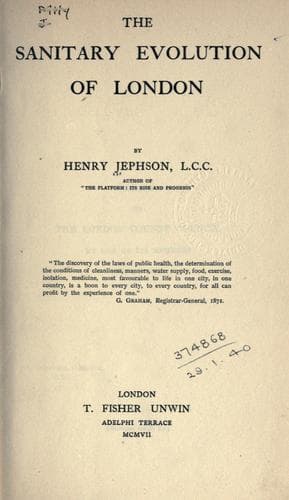
The Sanitary Evolution of LondonJephson, Henry (Henry Lorenzo)
History
The Sanitary Evolution of London
Jephson, Henry (Henry Lorenzo)
Public health -- England -- London
In the year 1879 the Board accordingly made representations to the
Government, and suggested that the owners of unhealthy houses should
not be compensated in proportion to the profit they derived from such
houses, but according to their value as places pronounced unfit for
habitation. The Board also pointed out--"the great loss entailed upon
the ratepayers by the obligation which the Board was under to provide
for the accommodation in suitable dwellings in the same area of at
least as many persons as were displaced. This obligation rendered it
necessary for the Board to sell, at a very low price, ground, which,
with the dilapidated buildings upon it, had cost the Board seven or
eight times as much, and which, if the Board had been free to dispose
of it for commercial purposes, and to provide for the dispossessed
people elsewhere, would have realised a much higher price."[139]
On the six areas which had been sold to the Peabody Trustees it
was estimated that the Board--or in other words, the ratepayers of
London--would lose the large sum of £562,000.
The Board suggested that it should have power to dispose of the cleared
ground for commercial purposes, and to provide for the re-housing of
the displaced families in other parts of London.
This latter suggestion was not adopted, but Parliament passed an Act
in 1879 which to some extent lessened, though it by no means removed
the defects of which the Board complained, for the Board declared that
"after careful consideration, it thought it well not to prepare any
more improvement schemes until some further experience has been gained
of the working of the Amendment Act of 1879."
And in 1879, also, an Act[140] was passed which nominally "amended,"
but in reality destroyed the real good of Torrens' Act of 1868, and
gave the owner power to require the local authority to purchase the
premises which had been condemned as unfit for human habitation, and
which the local authorities were to rebuild and hold--thus practically
relieving the worst class of slum house "owners" of any consequences
for their malpractices, relieving them, too, in the most open way at
the expense of the ratepaying public, as it empowered the Vestry "to
levy a rate of twopence in the pound to bear this expense as well as
that of building sanitary dwellings on the site."
By one means or another it invariably worked out that the slum owner
obtained large sums for his vile property, and that the public had to
pay heavily for his iniquities.
The work which was within the power of the Vestries and District Boards
to do, in connection with the sanitary condition of houses, was far
more wide-reaching in extent, and more immediately effective than
any the Central Authority could do under its powers. Practically the
Vestries had under their supervision the sanitary condition of all the
houses of London. Moreover they could act upon their own initiative,
whereas the Central Authority could only act when representations were
made to it.
Public-domain text, read in full here on John Shaqi.
Reviews
Reviews
No reviews yet
Be the first to share your thoughts on this work.
Elsewhere in the archive
Join the Discussion
Join the discussion
Sign in to leave a comment or review.
Sign InorCreate an account