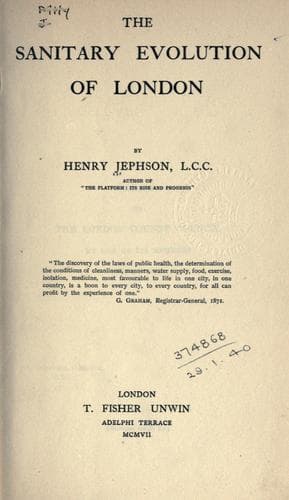
The Sanitary Evolution of LondonJephson, Henry (Henry Lorenzo)
History
The Sanitary Evolution of London
Jephson, Henry (Henry Lorenzo)
Public health -- England -- London
But with few exceptions, they resolutely fought shy of dealing with the
crucial evil--the condition of the tenement-house population of the
metropolis.
"There is no doubt," wrote the Medical Officer of Health for
Paddington, in 1871, "from the abundant experience and records of the
Sanitary Department of this and other Vestries, that houses let out
in single rooms, and to several families, have endangered the life of
people, have favoured the spread of contagion, and are a source of
pauperism and degradation."
The various Health Acts gave them power to deal with most of the
prevalent nuisances.
But no Act gave them such rapid and effective means of action, or so
fixed upon the owner the responsibility and cost of keeping his houses
which he let as tenement-houses in proper sanitary order, as did the
Act of 1866 by its 35th Section.
This Act had conferred power upon them to make effective bye-laws or
regulations as regarded such houses; and in 1874 the Sanitary Law
Amendment Act conferred further powers upon them. Regulations could now
be made as to the paving and drainage of premises, the ventilation of
rooms, the separation of the sexes, and to securing notices being given
to the Medical Officer of Health, and precautions being taken in case
of any dangerously infectious disease occurring in a registered house.
By such regulations the notification of infectious disease occurring in
tenement-houses could have been made compulsory, and such notification
would have been of the very utmost value in enabling sanitary
authorities to combat the ravages of infectious disease.
The regulations struck at the root of the very worst and most prevalent
evils in the homes of the people, and had they been enforced, would
have been a charter of health to millions of the people.
The Medical Officer of Health for Chelsea, in one of his reports, well
enforced their importance.
"When it is remembered that the whole of the labouring population
occupies but part of the house in which their families live; that in
many houses three or four families live together; and not infrequently
each family occupies only a single room; and when it is considered that
whenever necessary all such houses may be registered, it will at once
be seen how important is this regulation."[141]
These sections nevertheless remained absolutely a dead letter in nearly
every one of the metropolitan districts, and even the newly constituted
Local Government Board did not exercise its power of declaring them to
be in force in any district.
From a return compiled in 1874 it appears that:--
(_a_) In only seven parishes or districts[142] were regulations made
and enforced; how imperfectly even in these is illustrated by Lambeth
where, in 1873, 47 houses only had been registered--there being 29,000
in the parish, one half of which were probably let in lodgings.
(_b_) In six districts regulations were made but no attempt made to
enforce them.
Public-domain text, read in full here on John Shaqi.
Reviews
Reviews
No reviews yet
Be the first to share your thoughts on this work.
Elsewhere in the archive
Join the Discussion
Join the discussion
Sign in to leave a comment or review.
Sign InorCreate an account