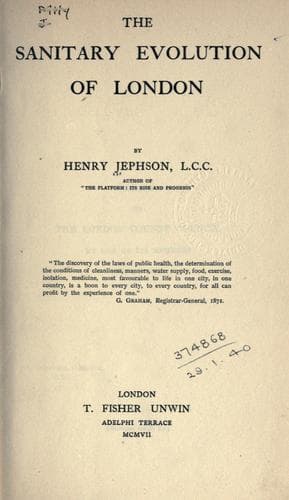
The Sanitary Evolution of LondonJephson, Henry (Henry Lorenzo)
History
The Sanitary Evolution of London
Jephson, Henry (Henry Lorenzo)
Public health -- England -- London
(_c_) And in twenty-five parishes or districts no regulations whatever
had been made.
In Hackney and Chelsea alone was any widespread use made of the
regulation.
The explanation usually put forward of the determination on the part of
the Vestries not to enforce the sanitary laws as regarded houses was
their regard for the financial interests of the ratepayers. But the
real ground of their aversion was that action would put house-owners to
expense. "Vested rights in filth and dirt" were strongly represented on
the Vestries and District Boards.
As a witness said before a Select Committee in 1882:--
"So long as vestrymen own little properties, and so long as their
relations and friends do the same thing, and they are all mixed up
in a friendly association, you can never get the prevention of the
continuance of unhealthy tenements carried through."[143]
And not only was there a passive but often an active opposition to work
being performed which it was their duty to do.
A general inspection would have shown what houses ought to have been
made subject to such regulations, but it would also have exposed too
publicly the iniquities of house-owners, and would have entailed a
heavy expense on those who left the houses in a perpetual state of
dilapidation, insanitation, and filth; and so the staff of inspectors
was kept as low as possible.
A thorough enforcement of the regulations would have necessitated a
supervision of their houses by the owners in addition to expense.
Many straws showed which way the wind blew. Thus the Medical Officer of
Health for Bethnal Green wrote:--
"It is by the constant inspection and reinspection of property
inhabited by careless and destructive tenants that most good can
be done. I recently felt it my duty to recommend a house-to-house
inspection of the whole parish--a procedure urgently required to
ascertain the condition of the drainage and water supply arrangements.
I regret to say this recommendation was not acted upon."
And the Medical Officer of Health for St. Pancras, in referring to
house-to-house inspection, wrote:--
"This most important branch of all sanitary work has received as much
attention as the number of the sanitary staff will admit."
And so the regulations were not made, or if made were not enforced.
And, as the result, the great masses of the working classes, and the
poorer classes in the metropolis, were by the deliberate decision of
the great majority of Vestries and District Boards deprived of the
protection which Parliament had devised and provided for their sanitary
and physical well-being; and all the well-known evils of overcrowding
were indefinitely perpetuated.
Apart from the sense of duty or responsibility to the people which
ought to have appealed to them, there were other motives which might
have done so.
The Medical Officer of Health for Paddington called attention to one of
them in 1872. He wrote:--
"The costliness of preventable disease is enormous.
Public-domain text, read in full here on John Shaqi.
Reviews
Reviews
No reviews yet
Be the first to share your thoughts on this work.
Elsewhere in the archive
Join the Discussion
Join the discussion
Sign in to leave a comment or review.
Sign InorCreate an account