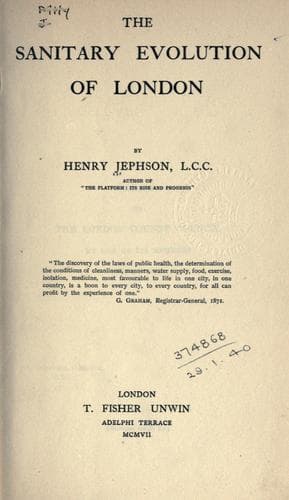
The Sanitary Evolution of LondonJephson, Henry (Henry Lorenzo)
History
The Sanitary Evolution of London
Jephson, Henry (Henry Lorenzo)
Public health -- England -- London
Parliament was passing some useful legislation for the improvement of
the public health, and taking some action against some of the more
heinous existing abuses.
Several of the evils already described connected with the building
of houses were dealt with in an Act[145] passed in 1878. It was at
last declared to be--"expedient to make provisions with respect to
the making, filling up, and preparation of the foundation of sites of
houses and buildings to be erected within the metropolis, and with
respect to the quality of the substances to be used in the formation or
construction of the sites, foundations and walls of such houses with
a view to the stability of the same, the prevention of fires, and for
purposes of health."
The Metropolitan Board of Works was empowered to make bye-laws
respecting the foundations and sites of houses to be constructed,
and with respect to the material used in the construction of such
houses and of the walls and buildings; and the Board issued a set of
comprehensive regulations upon the subject.
"Considerable opposition was manifested by builders before the
Secretary of State."
But, nevertheless, the regulations were sanctioned and approved.
And in the same year (1878) Parliament had passed an Act which
materially improved the sanitary conditions under which men, women, and
children worked in factories and workshops.[146]
Guided by experience, Parliament had gradually been extending the
operation of the previous Acts from one trade to another, and as Lord
Shaftesbury said:--
"The general result had been to introduce and establish a system
of order, content, and satisfaction. The children in the factories
presented quite a different appearance from that which was their
characteristic in former times; they were now hale and stout."
And the Factory and Workshops Royal Commission[147] in 1876 wrote:--
"The improvement in the sanitary arrangements and ventilation of
factories had been most marked in recent years; and the cases in which
young persons and women suffer in labour unfitted for their years, or
in which young persons and women suffer physically from overwork, are
now, we believe, as uncommon as formerly they were common.
"Much of this great improvement is undoubtedly due to factory
legislation."
The Act directed that:--
"A factory or workshop should be kept in a cleanly state and free from
effluvia arising from any drain, or other nuisance."
And that they should "not be so overcrowded while work is carried
on therein as to be injurious to the health of the persons employed
therein, and should be ventilated in such a manner as to render
harmless, as far as practicable, all the gases, dust, &c., generated in
the course of the manufacturing process and that may be injurious to
health."
By subsequent order of the Secretary of State, 250 cubic feet air space
were to be given to each adult during the day, 400 cubic feet after
eight o'clock at night.
Public-domain text, read in full here on John Shaqi.
Reviews
Reviews
No reviews yet
Be the first to share your thoughts on this work.
Elsewhere in the archive
Join the Discussion
Join the discussion
Sign in to leave a comment or review.
Sign InorCreate an account