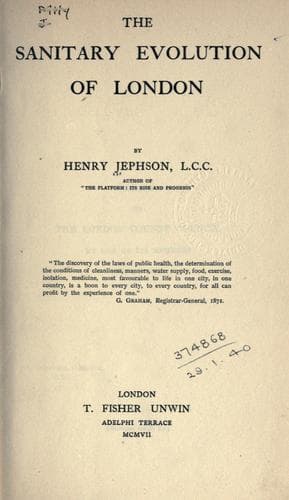
The Sanitary Evolution of LondonJephson, Henry (Henry Lorenzo)
History
The Sanitary Evolution of London
Jephson, Henry (Henry Lorenzo)
Public health -- England -- London
It was to be "the duty of the sanitary authority to make such inquiry
and to take such action thereon as to that authority may seem proper
for the purpose of enforcing the law."
A very material factor in the health of the people was dealt with in
this Act--namely, the condition of the bakehouses where the daily bread
of the community was prepared.
Legislation as to bakehouses had been left unchanged since the Act of
1863, and in harmony with the usual disregard of their duties by the
local sanitary authorities, little use was made of that Act.
The Royal Commission of 1875 reported that it was "only here and there
that any active steps had been taken by the local authorities to carry
out the provisions of the Bakehouse Act."
By the Act passed in 1878 the Bakehouse Regulation Act of 1863 was
repealed, and the duty of regulating the sanitary condition of
bakehouses was transferred from the local authority to the Inspectors
of Factories.
In 1878, also, the Contagious Diseases Animals Act was passed.
Primarily it was directed to the protection from cattle plague of the
cattle of the country, and the prevention of the spread of disease,
which had been entailing heavy losses upon their owners, and very
stringent precautions were imposed.
But it contained also some very valuable provisions as to the condition
of cowhouses and dairies, and early in 1879 the Privy Council issued
an Order providing for the registration of all persons carrying on the
trade of cowkeepers and purveyors of milk, for regulating the lighting,
ventilation, cleansing, drainage, and water supply of dairies and
cowsheds, for securing the cleanliness of milk stores, milk shops,
and milk vessels, and for protecting milk against infection and
contamination.
Inspectors were appointed by the Board.
"At the time of the passing of the Order the London cowsheds were,
with few exceptions, unsuitable in construction and in sanitary
arrangements. By opposing the renewal of licenses the Metropolitan
Board succeeded in abolishing from two to three hundred of the worst of
them, and obtained improvements, amounting to entire reconstruction,
in the remainder. In the larger dairies and milk stores much
improvement was also effected."
It was this Act of 1878 which drew from the Medical Officer of Health
for Whitechapel the following remarkable passages in his report;
passages which are enlightening as to the prevalent views of the time.
"We have a striking instance of the great interest that is shown in
the protection of property and the comparatively little value that is
attached to the health of the people in the recent Act--'The Contagious
Diseases Animals Act 1878.'
Public-domain text, read in full here on John Shaqi.
Reviews
Reviews
No reviews yet
Be the first to share your thoughts on this work.
Elsewhere in the archive
Join the Discussion
Join the discussion
Sign in to leave a comment or review.
Sign InorCreate an account