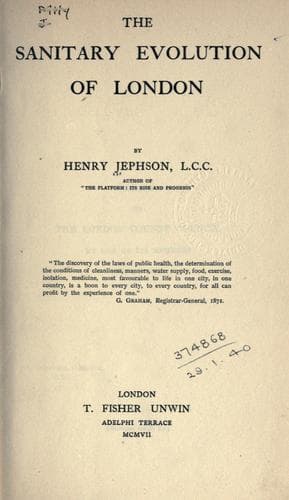
The Sanitary Evolution of LondonJephson, Henry (Henry Lorenzo)
History
The Sanitary Evolution of London
Jephson, Henry (Henry Lorenzo)
Public health -- England -- London
"Whilst the houses' drain-pipes, from defective construction and
workmanship, and want of being cut off from the main sewer, act as
much as sewer ventilators as channels for removing filth ... whilst
overcrowded houses and foul smells in living and sleeping rooms are
taken as a matter of course; whilst infectious disease is sedulously
propagated first by concealment, and then by criminal exposure and
neglect, ... so long the yearly recurring Herodean massacre of
helpless children, whose almost sole use in life appears to be the
providing of fees for doctors and undertakers, will continue, in spite
of all efforts of sanitary authorities and sanitarians."
The evil done, however, by bad sanitary conditions was not limited to
the children who died. Probably ten or twenty times the number of those
who died went through the illness and survived--but of those many were
injured in constitution for life.
In other respects, however, sanitary progress was being made, and
slowly but steadily the conditions of the health of the public were
improving. Undoubtedly the main causes of that progress were the great
system of main drainage and sewerage which had relieved London of the
incubus of enormous accumulations of the deadliest filth in its houses,
and of an open main sewer through its midst; and the greater quantity,
and improved quality, of the water supplied for household consumption
which relieved her inhabitants from the necessity of drinking liquid
sewage.
And the construction of sewers in nearly all the streets, and the
substitution of an effective system of house drainage instead of the
abomination of cesspools, was also a great stride to improvement.
Since 1856 plans for the construction of a total length of nearly 1,000
miles of local sewers had been submitted to the Metropolitan Board for
their approval, many of them being in substitution of old and shallow
ones for which the Board's new main and intercepting lines afforded the
means of improving the gradient and outlet.
In their report for 1881 the Metropolitan Board of Works gave "a brief
summary" of what it, as the Central Authority, had accomplished since
1856.
"There was the great main drainage work which had cost about five and
three-quarter millions, an undertaking which 'although fruitful of good
results, and of greater magnitude than anything of a similar kind that
had previously been accomplished, has left, as might be expected, few
visible marks of its existence.'"
It is rather the Thames embankments and broad new streets which remind
the inhabitants of London of the great changes and improvements that
the Board's operations effected.
Public-domain text, read in full here on John Shaqi.
Reviews
Reviews
No reviews yet
Be the first to share your thoughts on this work.
Elsewhere in the archive
Join the Discussion
Join the discussion
Sign in to leave a comment or review.
Sign InorCreate an account