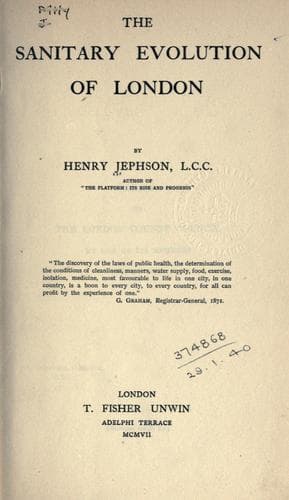
The Sanitary Evolution of LondonJephson, Henry (Henry Lorenzo)
History
The Sanitary Evolution of London
Jephson, Henry (Henry Lorenzo)
Public health -- England -- London
"On the north side of the Thames, from Blackfriars to Westminster,
and from Grosvenor Road to Battersea Bridge, and on the south side,
from Westminster to Vauxhall, embankments have been made which,
whilst reclaiming from the river a considerable extent of ground,
have substituted for the unsightly and offensive mud banks that
formerly prevailed, handsome river walls, with broad and commodious
thoroughfares, relieved and ornamented by public gardens. New streets
have been made, some of the principal of which are Queen Victoria
Street, Southwark Street, Northumberland Avenue, Commercial Road, and
the new thoroughfare from Oxford Street to Bethnal Green; many other
leading thoroughfares, which had become inadequate for the increased
traffic of the present day, have been widened and improved, greatly to
the convenience and comfort of the public; and liberal grants of money
have been made by the Board to the authorities in aid of the cost of
smaller street improvements which have not been of sufficient extent or
importance to be carried out by the Board.
"Two new parks have been provided, in districts previously unsupplied
with such places of needed recreation. Public gardens have been laid
out and are maintained in the neighbourhood of dense populations; and
suburban commons, to the extent of about 1,500 acres, have by the
action of the Board been secured in perpetuity for the undisturbed
enjoyment of the public.
"Many areas formerly covered with dwellings unfit for human habitation
have been cleared, under the operation of the Artizans' and Labourers'
Dwellings Improvement Act, and the ground let to societies which have
undertaken to build, and in some cases have built, improved dwellings,
in which the humblest class of the working population can live with
health, decency, and comfort."
These and many consequential improvements, and the better paving of
the streets, and the better cleansing of streets, places, and yards,
the more rapid removal of filth from London, had made the general
conditions of life much less unwholesome.
The work, too, being done by the Metropolitan Asylums Board was greatly
diminishing the dangers of infection in the metropolis, as well as
restoring to life and health thousands who would otherwise have fallen
victims to disease.
And by "The Poor Law Act, 1879," the Vestries and District Boards were
authorised to enter into contracts with the Board, for the reception
and treatment of infectious sick who were not paupers, thus in a
measure depauperising the Metropolitan Asylums Hospitals.
And a very large amount of most valuable work was done by the Port
Sanitary Authority; in the year 1879-80 over 15,000 vessels of all
classes having been visited and inspected, the infectious sick removed,
and disinfection carried out.
Writing of the year 1877 the Registrar General said:--
Public-domain text, read in full here on John Shaqi.
Reviews
Reviews
No reviews yet
Be the first to share your thoughts on this work.
Elsewhere in the archive
Join the Discussion
Join the discussion
Sign in to leave a comment or review.
Sign InorCreate an account