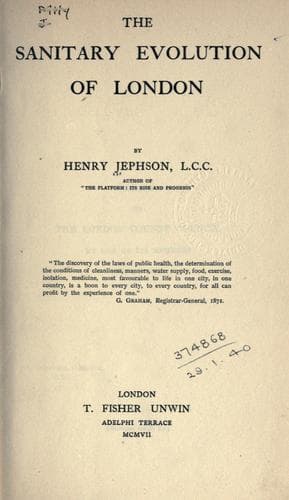
The Sanitary Evolution of LondonJephson, Henry (Henry Lorenzo)
History
The Sanitary Evolution of London
Jephson, Henry (Henry Lorenzo)
Public health -- England -- London
"London maintains its position as the healthiest city in the world.
During the past year its prosperity was indicated by a birth-rate
above the average of the preceding 10 years, while a remarkably low
death-rate bears testimony to the success which has attended the
efforts that have been made during the last half of a century to
promote the public health and safety."
Among the public authorities from which much might have been hoped in
the way of improving the public health of the inhabitants of London
was the School Board. The Board stood in an exceptionally favourable
position for moulding the physical constitution of hundreds of
thousands of children and of successive generations, but education
appeared to have almost excluded the consideration of health.
In 1871 the Board resolved "that it is highly desirable that means
shall be provided for physical training, exercise and drill in public
elementary schools established under the Board." But beyond this,
little if anything was done, and even it was not made applicable to
the girls. And no Medical Officer was appointed, and no systematic
means organised for the prevention of the diffusion of diseases by
the schools. Indirectly, however, good results were flowing from the
schools. The attendance of the children at the schools took them out of
their overcrowded tenement-homes for several hours in the day; their
playgrounds afforded better means of exercise; the cleanliness expected
of them raised their ideas as to cleanliness; the supervision over
them was of great use in improving their conduct and character, all
helped to improve their physical condition. But how infinitely greater
the improvement might have been, not merely at the time but to the
rising generation, if the School Board had given greater attention to
this branch of the children's welfare. About 230,000 children were in
attendance in the Board's Schools in 1880.
The really encouraging feature of the general position was that a
larger section of the public was taking an interest in matters relating
to the public health.
In Battersea, wrote the Medical Officer of Health (1881):--
"Much assistance is now derived from the general public, who are more
alive to the necessity of sanitary measures than at any previous
period."
The Medical Officer of Health for St. George-the-Martyr, Southwark,
reported:--
"The health of the people occupies the thought and consideration of an
ever-increasing number," and he quoted the declaration of the head of
the Government that "the sanitary question lies at the bottom of all
national well-being."
The Medical Officer of Health for North Poplar stated that--
"Gradually the labouring portion of the population, which so largely
outnumbers the remainder with us, is becoming educated to the fact that
they must neither breathe air, drink water, nor take food, polluted by
filth."
But, as a whole, public opinion was more or less inert.
Public-domain text, read in full here on John Shaqi.
Reviews
Reviews
No reviews yet
Be the first to share your thoughts on this work.
Elsewhere in the archive
Join the Discussion
Join the discussion
Sign in to leave a comment or review.
Sign InorCreate an account