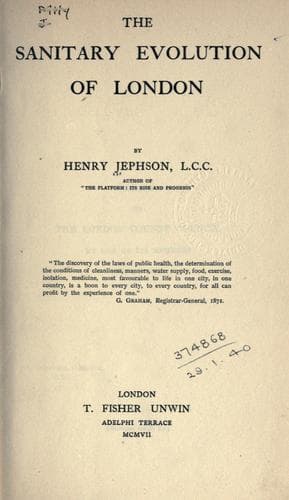
The Sanitary Evolution of LondonJephson, Henry (Henry Lorenzo)
History
The Sanitary Evolution of London
Jephson, Henry (Henry Lorenzo)
Public health -- England -- London
[129] See Sections 25 and 26 of the Sanitary Act, 1866.
[130] See Report of Metropolitan Board, 1871-2.
[131] P.P. 1878-9. Report of Local Government Board, vol. xxix., p.
xiii.
[132] By the Medical Officer of Health for Whitechapel, 1878.
[133] P.P. 1875, vol. lxiv.
[134] "The Artizans' and Labourers' Dwellings Improvement Act," 38 and
39 Vic. cap. 36.
[135] See Royal Commission Report, 1884.
[136] 1877, 24th March.
[137] Inquiry by Cubitt Nicholls, March 24, 1877.
[138] Appendix. Select Committee Housing, 1881, p. 354.
[139] See Report of Metropolitan Board, 1888.
[140] 42 and 43 Vic. cap. 64.
[141] The Medical Officer of Health for Chelsea (writing of his own
parish).
[142] Chelsea, Hackney, Shoreditch, Lambeth, St. George (Southwark),
Camberwell, Plumstead.
[143] Goddard, 1882, Select Committee, p. 576.
[144] Mr. Hunter Rodwell, Q.C., M.P.
[145] 41 and 42 Vic. cap. 32.
[146] 41 Vic. cap. 16.
[147] P.P., vol. xxix.
[148] J. Simon, vol. ii., 1874.
CHAPTER V
1881-1890
THE census of 1881 showed that the population of London was 3,816,483
persons--an increase this time of well over half a million of persons
in the decade.
In the central parts of London, with the single exception of
Clerkenwell, the resident population continued to decrease. In the
City, the decrease was nearly one-third; in the Strand nearly a fifth,
and the parish of St. George, Hanover Square, was now added to the list
of those on the decline.
In the East, in Whitechapel, Shoreditch, and St. George-in-the-East,
the population had declined, whilst in Bethnal Green the increase had
been at a much slower rate. But Mile-End-Old-Town, where there had
been a good extent of unbuilt-on ground, had added over 12,000 to its
population; and Poplar over 40,000.
In the North, with the single exception of St. Marylebone, all the
parishes showed increases; Hackney, the great increase of over 60,000,
and Islington the still larger one of nearly 70,000.
In the West, there were large increases in Paddington and Chelsea, in
Kensington an increase of over 42,000, and in Fulham over 48,000. In
the parishes nearer the centre--St. George, Hanover Square, St. James'
(Westminster), and Westminster, the population had decreased.
On the south side of the river, with the exception of the parishes of
St. Olave, and St. Saviour--both in Southwark, and near the City--every
parish or district showed an increase. Notably was this the case in
Camberwell, where the increase was 75,000, and most remarkable of all,
Wandsworth, where the huge increase of over 85,000 persons was recorded.
Thus the movements of population were shown by this census of 1881 to
be very much on the same lines as those in 1871--a diminution in the
central parts, and increases of various magnitudes in the outer parts.
Interesting information was once more given as regarded the constituent
parts of the population.
Public-domain text, read in full here on John Shaqi.
Reviews
Reviews
No reviews yet
Be the first to share your thoughts on this work.
Elsewhere in the archive
Join the Discussion
Join the discussion
Sign in to leave a comment or review.
Sign InorCreate an account