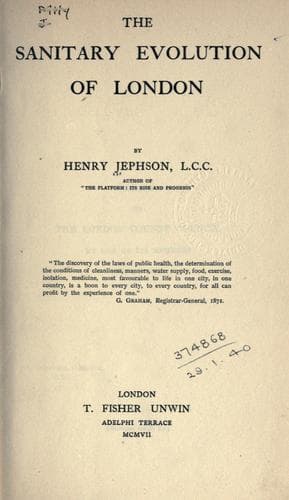
The Sanitary Evolution of LondonJephson, Henry (Henry Lorenzo)
History
The Sanitary Evolution of London
Jephson, Henry (Henry Lorenzo)
Public health -- England -- London
"The evil of overcrowding is aggravated by causes which derive their
origin from the effects of that condition itself. A lowered standard
of health, always the accompaniment of close building, is a factor in
the further increase of pressure in an already congested district.
An unsatisfied demand in the labour market for physical strength is
a necessary outcome of that quality in the district affected. Muscle
and bone in such a locality is at a premium, and that which cannot
be supplied in its full development from within must be sought and
obtained from without."
"Here, then, is a vicious circle of concurrent cause and effect.
Overcrowding is the cause of physical weakness: physical weakness
results in an unsatisfied demand in the labour market: the unsatisfied
demand is the cause of an influx from without: again that influx
results in overcrowding."
Once, then, that the influx of the physically strong began to
diminish--the element which had contributed most to the maintenance
of the physical vigour and health of the population of London--it
was evident that deterioration would ensue, and the only means of
counteracting that result was to improve to the utmost possible the
sanitary conditions in which the people lived.
The census of 1881 is remarkable as being the last to show an increase
of country-born immigrants into London. That tide was soon to begin to
ebb.
The immigrants, however, were far from being all of a desirable
character.
The Medical Officer of Health for Camberwell pointed this out:--
"A considerable percentage of our population is composed of persons
whose natural tendency is to grovel--beggars, thieves, prostitutes,
drunkards, persons of feeble intelligence, persons of lazy and
improvident habits, and persons who (like too many of the poor) marry
or cohabit prematurely and procreate large families for which they are
totally unable to provide; and such persons gravitate from all quarters
to large towns and there accumulate.... A large town like London will
always attract undesirable residents."
With the increasing population the number of houses in the metropolis
increased also.
From 418,802 inhabited houses in 1871 the number had gone up to 488,116
in 1881, and the same tale was told as to the crowding of houses on the
land as in previous years.
The Medical Officer of Health for Bethnal Green (1880) stated that
in his parish most of the available ground was already fully built
over. The Great Eastern Railway Company, the School Board for London,
and the Metropolitan Board of Works, were largely demolishing small
house property. "If this sort of thing goes on much longer," he
wrote, "it looks very much as if London in a few years would become a
huge agglomeration of Board Schools, intersected by railways and new
streets."
The correct record of the population enabled once more an accurate
death-rate to be calculated. The death-rate, which had been 24·6 per
1,000 in 1871, had fallen to 21·3 in 1881.
Public-domain text, read in full here on John Shaqi.
Reviews
Reviews
No reviews yet
Be the first to share your thoughts on this work.
Elsewhere in the archive
Join the Discussion
Join the discussion
Sign in to leave a comment or review.
Sign InorCreate an account