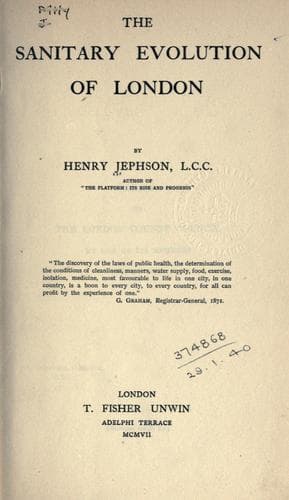
The Sanitary Evolution of LondonJephson, Henry (Henry Lorenzo)
History
The Sanitary Evolution of London
Jephson, Henry (Henry Lorenzo)
Public health -- England -- London
That was most gratifying testimony to the good results following the
sanitary work carried out, under many difficulties, in London, and an
encouragement to perseverance.
The vital subject of the housing of the huge masses of the people of
London was, during all the earlier years of this decade of 1881-90,
uppermost in the minds of those who were solicitous for their welfare.
The Act of 1879 had done but little to help to a solution of the
tremendous problem.
A short experience of it, and of "Cross's" Housing Act, had shown
that instead of "owners" being visited with heavy penalties for their
iniquities, they were being actually rewarded. In fact, they secured
under these Acts not only a full, but an inordinately high compensation
for their property--regardless of its infamous condition--and the
ratepayers of London were mulcted in large sums to pay them for it.
"I desire," said the Medical Officer of Health for Hackney in 1883, "to
express a very strong opinion that it is most unfair to the ratepayers
that they should be compelled to pay for uninhabitable property which
has been allowed by the owners to get into a dilapidated state for want
of substantial repairs such as cannot be required under the Nuisances
Removal Acts...."
The first scheme which was initiated by the Metropolitan Board in 1875
was only completed at a net cost of £151,763, which sum had to be borne
by the ratepayers of London; though why they should have been made to
pay for the "owners" neglect which had led to the evil conditions of
his property is not very clear, except that Parliament willed it so.
By 1882 the total number of insanitary areas dealt with by the
Metropolitan Board, or in process of being dealt with, was fourteen.
The houses in these areas had been inhabited by 20,335 persons in 5,555
separate holdings, 3,349 of which consisted of one room only.[151]
They were acquired by the Board at a cost of £1,661,000. Parliament
had imposed upon the Board the obligation to provide accommodation
for at least as many persons of the working classes as were displaced
by the destruction of the houses on these areas. As the Board were
not empowered to undertake the building of the houses in which to
re-accommodate the displaced persons, the sites, after having been
cleared, had to be sold to persons or companies, who were put under the
obligation to erect workmen's dwellings thereon; but inasmuch as the
land had been bought at its value for commercial purpose, which was
far higher than its value for residential houses, this Parliamentary
obligation entailed upon the Metropolitan Board, and through them upon
the ratepayers of London, an enormous loss.
The Goulston Street scheme in Whitechapel, for instance, was acquired
at a cost of £371,600. When sold, under the conditions imposed by
Parliament, it realised only £87,600; and the Whitecross Street scheme
(in St. Luke's), which cost £391,000, when sold realised £76,350.
Public-domain text, read in full here on John Shaqi.
Reviews
Reviews
No reviews yet
Be the first to share your thoughts on this work.
Elsewhere in the archive
Join the Discussion
Join the discussion
Sign in to leave a comment or review.
Sign InorCreate an account