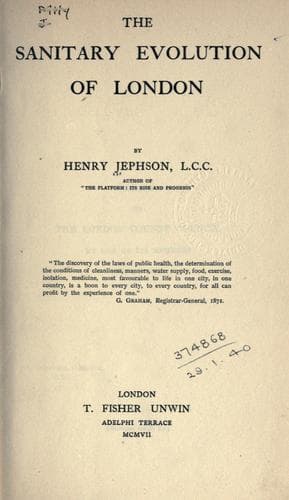
The Sanitary Evolution of LondonJephson, Henry (Henry Lorenzo)
History
The Sanitary Evolution of London
Jephson, Henry (Henry Lorenzo)
Public health -- England -- London
In Poplar, 2,114 houses were inspected, of which only 334 were found to
be in good order.
In Lambeth, six men were engaged temporarily for the purpose of a
special inspection.
"11,493 houses were visited; 5,594 required sanitary improvements....
In many houses several defects were reported, bringing up the total of
sanitary improvements to 12,014."
In Bermondsey, no fewer than 5,992 notices were issued for the
execution of sanitary works which were required.
The Sanitary Act of 1866 had enacted that--
"It shall be the duty of the Nuisance Authority to make, from time to
time, either by itself or its officers, inspection of the district with
a view to ascertain what nuisances exist calling for abatement under
the powers of the Nuisances Removal Acts, and to enforce the provisions
of the said Acts in order to cause the abatement thereof."
But by many Vestries the duty had been either entirely neglected or
very imperfectly performed.
The Medical Officers of Health were unceasing in pressing upon their
employers the necessity of inspection.
"It is only by the constant inspection and re-inspection of property
inhabited by tenants of this class (tenement-houses) that the houses
can be kept in decent sanitary condition," wrote the Medical Officer of
Health for Bethnal Green.
"My opinion of the value of regular house-to-house inspection
throughout the year," wrote the Medical Officer of Health for Poplar,
"is more confirmed than ever, and that such is needed for the proper
sanitary supervision of the district."
"It is by constant inspection," wrote another Medical Officer of
Health, "that the Vestry can best do its duty in preserving the lives
and health of its parishioners."
"Facts are stubborn things," wrote the Medical Officer of Health for
St. Mary, Newington, after 28 years' sanitary work himself, "and they
clearly demonstrate the necessity for a continual supervision of the
dwellings of the poor (more especially) and for as constant an attack
on all removable insanitary conditions. This after all is the real work
to be done."
But the Vestries and District Boards paid little heed to this advice.
Naturally, inspection was not welcome to sanitary defaulters or
misdoers; naturally, the light of the sanitary policeman's lantern
into the dark places of slum-owners and 'house-knackers' was resented.
It was an invasion of the rights of property, of the privacy of an
Englishman's home, even if he did not live in that home himself, but
let it to somebody else to live in. "Why should not a man do as he
liked with his own?"
Public-domain text, read in full here on John Shaqi.
Reviews
Reviews
No reviews yet
Be the first to share your thoughts on this work.
Elsewhere in the archive
Join the Discussion
Join the discussion
Sign in to leave a comment or review.
Sign InorCreate an account