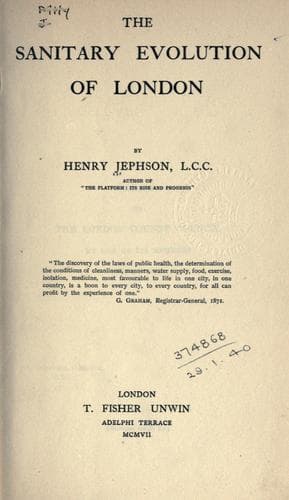
The Sanitary Evolution of LondonJephson, Henry (Henry Lorenzo)
History
The Sanitary Evolution of London
Jephson, Henry (Henry Lorenzo)
Public health -- England -- London
And so, as inspection was, from the house "owners'" point of view,
an unpopular thing, too much money was not spent by Vestries upon
Sanitary Inspectors' salaries, and even in the best inspected parishes
or districts the portion inspected was small indeed compared with the
whole of the parish or district. How much was left undone, and left
undone for years, was proved over and over again by whole areas being
represented by their Medical Officers of Health as insanitary, or by
their having to shut up houses as unfit for human habitation.
The attempt made by Parliament in 1866--in the scheme embodied in the
35th Section of the Sanitary Act--to provide a remedy for overcrowding,
and to secure the maintenance of a moderate standard of cleanliness
and sanitation in the tenement-houses, had been an excellent one; and
Parliament improved the scheme in 1874 by extending its scope. Almost
the whole of the existing evils lay in these tenement-houses, for it
was there where the great mass of the disease, filth, and misery of
London was to be found, and there where the greatest overcrowding, and
the deepest moral and physical degradation existed.
But with the few exceptions already described practically no use had
been made of the powers.
"Vested rights in filth and dirt" had still too large a representation
upon, and too powerful a grip of the local sanitary authorities for any
action to be adopted which would entail trouble upon the possessors of
those rights.
Some Vestries, for form's sake, had made regulations but never put them
in force. A few had tentatively put them in force, and promptly dropped
them. A large proportion of them did not take even that much trouble,
but simply ignored them altogether; and so, some seventeen years after
the Act was passed, the whole scheme had ceased to be operative, and
was in complete abeyance.
In December, 1883, the Local Government Board, having realised the
gravity of the situation, endeavoured to get the Vestries and District
Boards to take action, but the Local Government Board could not compel
them to make such regulations, as there was no power of compulsion, and
there was no penalty for refusal to enforce or even to make them.[155]
The Vestries and District Boards were, in fact, masters of the
situation, and could act or not act, just as they pleased--and most of
them did not act.
Various were the excuses made by the Vestries for doing nothing.
The feeling which prevailed in the Vestry of Clerkenwell was that--
"The regulations generally were of such an inquisitorial and
troublesome character that they were unsuited to an Englishman's home.
For instance, it was shown that in some cases even clergymen occupied
lodgings which would be reached by these regulations."
Public-domain text, read in full here on John Shaqi.
Reviews
Reviews
No reviews yet
Be the first to share your thoughts on this work.
Elsewhere in the archive
Join the Discussion
Join the discussion
Sign in to leave a comment or review.
Sign InorCreate an account