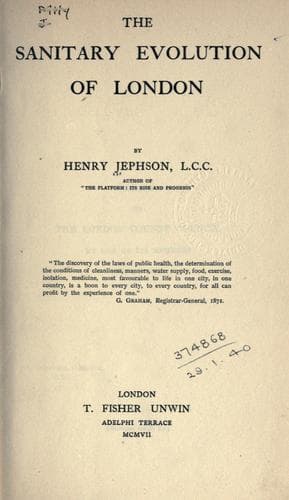
The Sanitary Evolution of LondonJephson, Henry (Henry Lorenzo)
History
The Sanitary Evolution of London
Jephson, Henry (Henry Lorenzo)
Public health -- England -- London
While the great question of housing and overcrowding was under
discussion and was being investigated, and efforts being made to deal
with it, various other matters forming part of the general sanitary
evolution of London were attracting attention, or gradually developing.
In October, 1882, the limits of the Port of London were extended
seawards, and in the following year the powers of the Port Sanitary
Authority were extended.[164] Most of the powers of an Urban Sanitary
Authority under the Public Health Act of 1875 were conferred upon
it, and the Medical Officer of Health reported that he believed the
legal powers of the Authority would be found "amply sufficient for the
sanitary control and supervision of the Port."
The Authority extended its attention now to the inspection of imported
meat. It was a matter of the first importance to watch carefully the
food supply of the people. The trade of frozen meat had been rapidly
growing, and from time to time large quantities arrived in unsound
condition, which it was most necessary should be prevented going on to
the market.
In connection with another very important article of food--namely,
milk--action was also taken.
The effect of the order made in 1879 by the Privy Council, as to
dairies, cowsheds, and milkshops, had been very beneficial, and a
marked change for the better in the conditions under which the milk
trade was conducted was the result. That Order was revoked in 1885 by
the Privy Council, and a new one passed extending the powers of local
authorities in the matter, and prescribing further precautions to
secure the sanitary condition of all dairies and cowsheds, and for the
protection of milk against infection or contamination.
Another beneficial sanitary improvement was effected in 1883, by
the extension of the benefits of the infectious hospitals of the
Metropolitan Asylums Board.
The Royal Commission on Fever and Smallpox Hospitals, in 1882,
stated that in their opinion it was of paramount importance that the
hospitals of the Metropolitan Asylums Board, to which so many classes
of persons might become liable to be removed, should be made as little
unattractive as the nature of the case admitted, and they considered
that the pauper character which attached to the hospitals of the Board,
and which rendered them repulsive to all but the indigent, would
disappear if the distinction between paupers and non-paupers were
abolished.
This suggestion was partially given effect to by the Diseases
Prevention (Metropolis) Act of 1883, which enacted that, subject to
certain arrangements, the admission of any person suffering from
infectious disease into any hospital provided by the Metropolitan
Asylums Board, or the maintenance of any such person therein, should
not be considered to be parochial relief.
The plan was only partly successful, but as years went on the hospitals
were increasingly used by persons other than those of the legally
recognised pauper class.
Public-domain text, read in full here on John Shaqi.
Reviews
Reviews
No reviews yet
Be the first to share your thoughts on this work.
Elsewhere in the archive
Join the Discussion
Join the discussion
Sign in to leave a comment or review.
Sign InorCreate an account