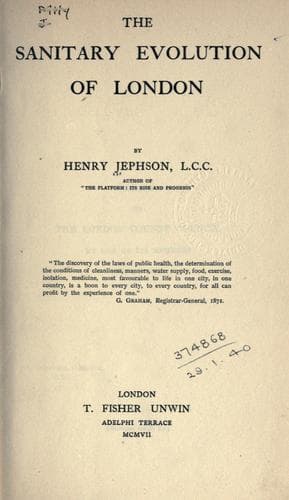
The Sanitary Evolution of LondonJephson, Henry (Henry Lorenzo)
History
The Sanitary Evolution of London
Jephson, Henry (Henry Lorenzo)
Public health -- England -- London
In the years 1884 and 1885 the hospitals demonstrated their great
utility. There was a severe epidemic of smallpox. From its outbreak in
1884, to its subsidence in the autumn of 1885, no less a number than
12,425 patients passed through the hospitals, hospital ships, and camps
of the Metropolitan Asylums Board, and the arrangements for the removal
to hospital of cases of infectious disease, from the whole of the
metropolis, worked smoothly and satisfactorily.
The gain to the community in thus removing infectious cases from its
midst was immeasurable.[165]
In 1885 the Report of the Royal Commission which had been inquiring
into the Housing of the Working Classes was published. It presented
to the general public a mass of facts of which previously they had
taken but little heed, and the vast importance of which they had
utterly failed to realise; and it brought into the forefront of social
questions the vital question of the public health, and the imperative
necessity of remedying evils which were eating into the very vitals of
the community.
The Royal Commissioners depicted the widely prevalent and dreadful
overcrowding which existed, and which in certain localities was
becoming more serious than ever, and they gave numerous instances of
it. They described the fearsome condition of tenement-houses, and of
the people living therein--the inadequacy of the water supply--the
defective sanitary accommodation in houses--the lack of air space--the
absence of ventilation--the use of cellars and underground rooms as
dwelling-places--the limitless filth.
And they pointed out the dreadful results of this condition of
things--physical, moral, and material--the prevalence of disease,
the heavy death-rate, the destruction of bodily health, the dreadful
immorality resulting from overcrowding, the degradation to which masses
were doomed, the incitement to drink, and depravity, and crime. They
declared that:--
"Even statistics of actual disease consequent on overcrowding would not
convey the whole truth as to the loss of health caused by it to the
labouring classes....
"Nothing stronger could be said in describing the effect of
overcrowding than that it is even more destructive to general health
than conducive to the spread of epidemic and contagious diseases."
And they pointed out that there was much legislation designed to meet
these evils, yet that the existing laws were not put in force, some of
them having remained a dead letter from the date when they first found
place in the statute book.
And they investigated the causes of many of these things--and they
assigned the blame for some of them--and they passed in review the
conduct of the local governing authorities--and they recapitulated
the existing laws upon these various matters, and suggested certain
alterations, and made various valuable recommendations.
Public-domain text, read in full here on John Shaqi.
Reviews
Reviews
No reviews yet
Be the first to share your thoughts on this work.
Elsewhere in the archive
Join the Discussion
Join the discussion
Sign in to leave a comment or review.
Sign InorCreate an account