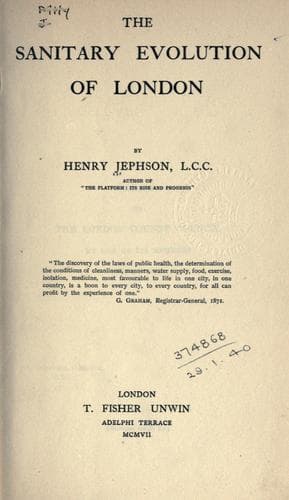
The Sanitary Evolution of LondonJephson, Henry (Henry Lorenzo)
History
The Sanitary Evolution of London
Jephson, Henry (Henry Lorenzo)
Public health -- England -- London
"It has been long known to the Sanitary Committee that there has never
been any efficient supervision of the drainage and other sanitary
arrangements of houses in course of construction.... It is true that
every builder has been required before constructing his private drains
and connecting them with the public sewers, to send in a plan of his
proposed drainage for the sanction of the Surveyor. But there has been
no machinery by which builders could be compelled to carry out their
private works in accordance with the plans submitted, and to ensure
that the details of their works had been carried out in a workmanlike
or efficient manner. The inspections of houses even recently built have
shown that sanitary nuisances complained of have been largely due to
scandalous neglect of duty on the part of those concerned in carrying
out the drainage works, and that in most cases the plans sent in have
not accorded with the arrangements finally adopted."
Various, indeed, were matters connected with the public health which
unexpectedly came cropping up; sometimes matters thought to have been
disposed of but only partly so, sometimes, wholly new origins and
ramifications of insanitation.
Thus in 1886 the Medical Officer of Health for the south part of
Poplar District drew special attention to a grievance long previously
complained of and for many years endured.
"A greater scandal cannot well be shown in matters vital to health
than that in spite of abundant evidence of the magnitude of the evil,
thousands and tens of thousands of families living in houses, the rates
of which are payable by the landlords, may at any moment, without a
particle of fault of their own, be suddenly denied one of the first
necessaries of life--water--through the neglect and wilfulness of
others."
The main remedy open to the water companies to recover rates from
defaulting non-resident owners of tenement-houses was the simple
expedient of discontinuing the supply of water. This course was open
to a double objection--first, tenants who had paid their rent were
deprived of that for which they had constructively paid; and secondly,
a tenement-house deprived of water might speedily become a focus of
disease.
"That disease and death are directly traceable to this want," wrote the
Medical Officer of Health, "no one acquainted with sanitary work in
London can doubt. Take this instance. Water cut off, drains stopped,
opening up of ground and drains, removal of filth accumulations, horrid
stench, diphtheria, death.
"In Hanbury Place--having six houses--there was no water supply for
twenty-six days, and families numbering each seven, nine, two of six,
and others had to exist in May, 1885, with choked drains, yard flooded
with sewage, and no water--and all because of non-payment of rates by
the landlord."
In 1887 Parliament happily dealt with this evil, and by an Act passed
in that year--
Public-domain text, read in full here on John Shaqi.
Reviews
Reviews
No reviews yet
Be the first to share your thoughts on this work.
Elsewhere in the archive
Join the Discussion
Join the discussion
Sign in to leave a comment or review.
Sign InorCreate an account