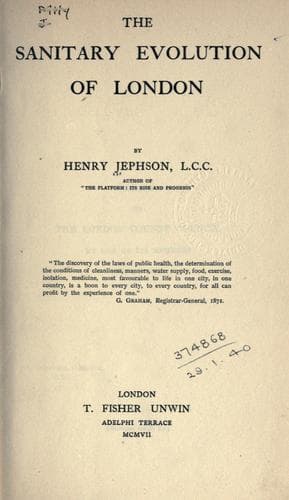
The Sanitary Evolution of LondonJephson, Henry (Henry Lorenzo)
History
The Sanitary Evolution of London
Jephson, Henry (Henry Lorenzo)
Public health -- England -- London
"Water companies were prohibited from cutting off the water supply from
any dwelling-house for non-payment of water rate, if such rate were
payable by the owner and not the occupier of the premises...."
In the middle of this decade, too, anxiety revived, owing to the state
of the Thames, a matter which it was hoped had been finally disposed
of. The discharge of sewage at the new outfalls make the river in those
parts much what it had previously been in London.
A Royal Commission was appointed to inquire into the subject. They
reported that they found a condition of things which they "must
denounce as a disgrace to the metropolis and to civilisation." They
said that in 1884 "the sewage water from the outfalls manifestly
reached London Bridge."
"At Greenwich Pier the water was very black, and the smell exceedingly
strong."
"At Woolwich the river for its whole width was black, putrid,
sewage--looking as if unmixed and unalloyed. The stench was
intolerable."
"We are of opinion that it is neither necessary nor justifiable to
discharge the sewage of the metropolis in its crude state into any part
of the Thames."
This evil was surmounted by the adoption by the Metropolitan Board
of Works of a system of treatment of the crude sewage. Chemical
precipitation was effected by adding to the sewage certain proportions
of lime and protosulphate of iron, and allowing it to remain for an
hour or two in settling tanks. The effluent water was let flow into the
river, and the sludge was carried down the river in barges and cast
into the sea.
The public interest evoked by the inquiries made by the Royal
Commissioners on Housing, and the publication of their Report,
certainly quickened the activity of many of the local authorities.
In several of the parishes and districts the Regulations under the
Sanitary Acts of 1866 and 1874 were being more readily adopted, and
being put into force on a slightly more extended scale; and in every
case it was reported that the results had been satisfactory, a great
improvement taking place in the houses which were registered.
A report of the Inspector of such houses, for Bermondsey, describes
this well:--
"108 were placed on Register by Vestry. The majority of these houses
are situated in the lowest and most densely populated parts of the
parish. They are occupied by the very poor, costermongers, dock
and waterside labourers, &c. They contain 509 rooms, occupied by
386 families, numbering 1,434 persons. 285 rooms were overcrowded.
With three exceptions the overcrowding has been abated. Previous to
registration the number in each house was 13, present average 9."
"The sanitary condition of the said houses has been greatly improved.
Staircases, &c., are now regularly swept and washed. In 85 houses the
walls have been stripped and whitewashed. Many of the walls had 15
layers of paper, thus hiding filth and harbouring vermin. Ventilation
in them is also improved. Many owners rendered much assistance."
Public-domain text, read in full here on John Shaqi.
Reviews
Reviews
No reviews yet
Be the first to share your thoughts on this work.
Elsewhere in the archive
Join the Discussion
Join the discussion
Sign in to leave a comment or review.
Sign InorCreate an account