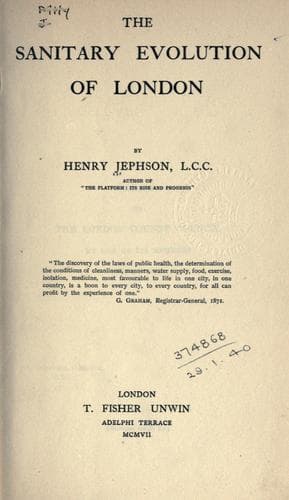
The Sanitary Evolution of LondonJephson, Henry (Henry Lorenzo)
History
The Sanitary Evolution of London
Jephson, Henry (Henry Lorenzo)
Public health -- England -- London
"The object of the sweater being his own gain, the inevitable tendency
of such a system is to grind the workers down to the lowest possible
level....
"The character of the workshops, or places used as workshops, varies
considerably. The smaller sweaters use part of their dwelling
accommodation, and in the vast majority of cases work is carried on
under conditions in the highest degree filthy and unsanitary."
"In small rooms, not more than nine or ten feet square, heated by a
coke fire for the pressers' irons, and at night lighted by flaring gas
jets, six, eight, ten, or even a dozen workers may be crowded.
"The conditions of the Public Health Acts, and of the Factory and
Workshop Regulation Acts, are utterly disregarded, and existing systems
of inspection are entirely inadequate to enforce their provisions even
if no divided authority tended to weaken the hands of the Inspectors.
"Some of the shops are hidden in garrets and back rooms of the worst
kinds of East End tenements, and a third of them cannot be known to the
Factory Inspectors.
"It is in regulating the hours of the women that factory inspection
should be of most service, but how can two or three Inspectors keep
in check the multitude of sweating dens of East London? Basements,
garrets, backyards, wash-houses, and all sorts of unlooked for and
unsuspected places are the abodes of the sweater."
Early in the following year Lord Dunraven, in the House of Lords, moved
for the appointment of a Select Committee to inquire into the sweating
system.
"The evils which existed there were caused by natural laws which were
not by any means of necessity unwholesome in any degree.... But his
belief was that though the causes were perfectly natural in themselves
they had been allowed to run riot, and had not been put under proper
control, and had thus produced the present terrible state of things....
"Large workshops were the exception. In the 'dens' of the sweaters
there was not the slightest attempt at decency; men and women worked
together for many consecutive hours, penned up in small rooms and
basements, garrets, backyards, wash-houses, and all sorts of unlikely
places, were the abodes of the sweaters."
And he quoted the Chief Inspector of Factories and Workshops:--
"To add to the evils of overwork pursued by these people, we must note
the overcrowded, ill-ventilated, and excessively hot state of the
workrooms; ... it is surprising how such people can live under such
conditions.
"... It was," he said, "a ridiculous and scandalous thing that
Parliament should pass Factory and Sanitary Acts regulating the hours
of labour of women and children, and that those Acts should be grossly
violated."
Lord Sandhurst said:--
"It might appear to their Lordships almost incredible that within three
or four miles of that House a state of things, involving so much human
misery, could possibly exist as was to be found at the East End of
London."
Public-domain text, read in full here on John Shaqi.
Reviews
Reviews
No reviews yet
Be the first to share your thoughts on this work.
Elsewhere in the archive
Join the Discussion
Join the discussion
Sign in to leave a comment or review.
Sign InorCreate an account