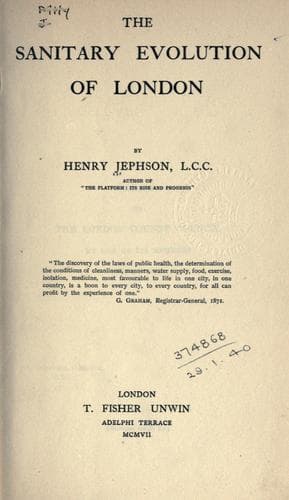
The Sanitary Evolution of LondonJephson, Henry (Henry Lorenzo)
History
The Sanitary Evolution of London
Jephson, Henry (Henry Lorenzo)
Public health -- England -- London
"In my district we have a population of about 130,000, and about
18,000 houses, and we have two Inspectors. Of course there should
be periodical inspection, that is to say, every house in the parish
should be visited at least once a year by a Sanitary Inspector, but
that with the present staff would be utterly impossible. In my district
there is no house-to-house visitation; we simply attend to complaints
as we receive them, and this completely fills up the time of the two
Inspectors."
And he further stated[167]:--
"In my district the Sanitary Inspectors are not under the control of
the Medical Officer of Health."
It is of course manifest that if houses had not been inspected, and the
necessary sanitary improvements enforced, things would have gone on
rapidly deteriorating, and with that deterioration would have come all
those causes of disease which would endanger the lives of the occupants
and create fresh centres for spreading disease broadcast.
It might have been thought that the numerous inquiries into the
condition of the working classes in factories and workshops would have
laid bare nearly all there was to lay bare.
A report to the Board of Trade on the Sweating System in the East
End of London, by J. Burnett in 1887, rudely dispelled such an idea,
and opened out to public view a new vista of causes, deleteriously
affecting the public health, a new area of insanitation. Though the
evils depicted had become acuter, they evidently had been going on for
years.
"The system may be defined as one under which sub-contractors undertake
to do work in their own houses or small workshops, and employ others
to do it, making a profit for themselves by the difference between the
contract prices and the wages they pay their assistants.
"The mass of those employed under the sweating system labour in
workshops where much fewer than 20 are engaged, or in the houses which
may be single rooms of the 'small sweaters.'"
After referring to the numerous branches of the tailoring trade, he
said:--
"Immense numbers of people of both sexes and all ages have rushed into
the cheap tailoring trade as the readiest means of finding employment.
The result has been an enormously overcrowded labour market, and a
consequently fierce competition among the workers themselves, with all
the attendant evils of such a state of things.... Matters have been
rendered infinitely worse by an enormous influx of pauper foreigners
from other European nations. The result has been to flood the labour
market of the East End of London with cheap labour to such an extent as
to reduce thousands of native workers to the verge of destitution...."
"There are, of course, in addition many English workers employed in the
same trade and in the same shops, but their number is gradually being
reduced, owing to the severity of a competition in which those who can
subsist on least are sure to be victorious.
Public-domain text, read in full here on John Shaqi.
Reviews
Reviews
No reviews yet
Be the first to share your thoughts on this work.
Elsewhere in the archive
Join the Discussion
Join the discussion
Sign in to leave a comment or review.
Sign InorCreate an account