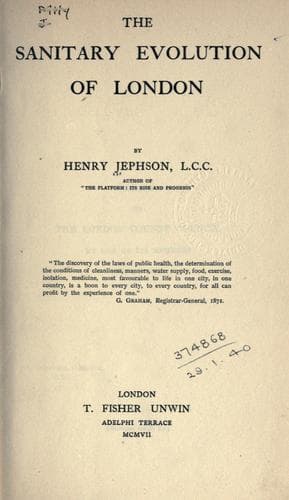
The Sanitary Evolution of LondonJephson, Henry (Henry Lorenzo)
History
The Sanitary Evolution of London
Jephson, Henry (Henry Lorenzo)
Public health -- England -- London
"We cannot," reported the Sanitary Committee of the Council, "too
strongly emphasise our opinion that the London County Council should
be empowered to frame bye-laws for the proper sanitary government of
London, that the new or existing local bodies should put them in force,
and that the County Council should be the supervising body to see that
they are properly carried out."
A somewhat similar report was made by the Housing of the Working
Classes Committee.
"The Committee," they said, "feels that until the law is strengthened,
and fuller powers to enforce the law are placed in the hands of the
Council, its action in dealing with insanitary areas will be of an
imperfect character."
The question of the housing of the poor in London was at once
energetically taken up by the new body.
Representations were made to the Government as to the necessity of the
Acts relating to the housing of the working classes being consolidated
and amended.
Consequent upon this, the Government introduced a Bill which was
passed--"The Housing of the Working Classes Act, 1890,"[170] which
repealed and codified fourteen enactments, all having for their object
the improvement of the dwellings of the artizan and labouring classes,
and the clearing away of unhealthy areas. Very large powers were placed
in the hands of the Council and of the district authorities to secure
the better housing of the working classes. And the Act may be said to
mark a new era in the history of reform in the matter of insanitary
areas, giving full power to the Council as a central authority to
enforce its provisions.
Before the end of this decade Parliament passed two other Acts of great
advantage to the health of London. One was, "The Infectious Diseases
Notification Act, 1889," making the notification of certain specified
diseases compulsory in London--smallpox, cholera, diphtheria,
membraneous croup, erysipelas, scarlet fever, typhus, and other fevers.
In accordance with well-worn usage London had been left behind in
this matter. Other cities and even towns had, by means of local Acts,
secured the advantages of such legislation long before. So far back
as 1874, indeed, machinery had been in existence in London for the
notification of infectious disease in houses let in lodgings. But owing
to the neglect of the majority of the Vestries and District Boards
to make or enforce regulations under the Sanitary Act of 1866, that
machinery was left unused to the great detriment of the people of
London. Thousands of lives must have been sacrificed by this neglect,
and innumerable cases of preventable disease not prevented. It was not
until a general Act was passed that London became possessed of the
advantages resulting from such notification.
In London, indeed, the health of cattle was better looked after in this
respect than that of the people, for cases of infectious disease in
cattle had to be notified to the Sanitary Authorities.
Public-domain text, read in full here on John Shaqi.
Reviews
Reviews
No reviews yet
Be the first to share your thoughts on this work.
Elsewhere in the archive
Join the Discussion
Join the discussion
Sign in to leave a comment or review.
Sign InorCreate an account