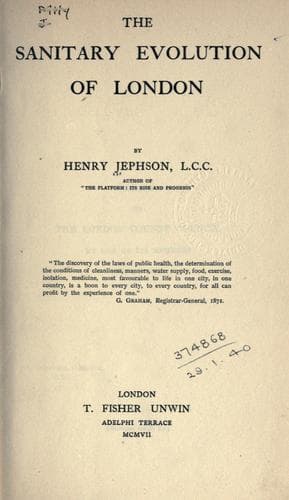
The Sanitary Evolution of LondonJephson, Henry (Henry Lorenzo)
History
The Sanitary Evolution of London
Jephson, Henry (Henry Lorenzo)
Public health -- England -- London
By this Act it was made compulsory on medical attendants to certify,
and on householders to notify, the existence of any of these diseases.
Hitherto information as to infectious illness only reached the Medical
Officer of Health after a sufficient time had elapsed to allow of the
spread of the infection.
The results of the Act of 1889 were soon found to be very beneficial in
checking the spread of disease.
The receipt of the notices of infectious diseases led to the more
prompt and general disinfection of premises where infectious diseases
prevailed, and led also to the discovery of sanitary defects which
might not otherwise have been discovered.
The information, moreover, kept the Medical Officers of Health informed
of the progress of disease not only in their own districts, but also in
contiguous ones, and so assisted them to take prompt measures for the
eradication of disease in their respective districts.
The other measure which passed the legislature in this same year
contained provisions of the highest importance as affecting the
metropolis. This was "the Poor Law Act, 1889."
Until 1889 patients could be admitted only to the infectious hospitals
of the Metropolitan Asylums Board on the order of the Relieving
Officer and District Medical Officer, so, except in certain cases, the
hospitals were only open to Poor Law cases.
This measure made practical concession of two principles. Free
admission to the hospitals of the Metropolitan Asylums Board of sick
persons in need of isolation, and devolution upon the Metropolitan Poor
Fund of all charges incurred in the maintenance of the sick in those
hospitals.
The Managers were, therefore, enabled to admit other than pauper
patients reasonably believed to be suffering from fever, smallpox, or
diphtheria.
The system was attended with the happiest results in reducing the
amount of infectious disease in the metropolis, and proved a great boon
to all classes of the community.
The Board in its annual report wrote:--
"The Managers are now, for the first time since the establishment of
the Board in 1867, virtually recognised as the Metropolitan Authority
for the provision of accommodation for the isolation and treatment of
infectious disease--both pauper and non-pauper--and are now empowered
to legally perform duties which the Legislature had imposed on the
District Sanitary Authorities, but which the Managers had hitherto been
called upon to perform in consequence of the failure of most of such
Authorities to provide accommodation for non-pauper patients."
The Managers by this date had increased the accommodation for patients
afflicted with any of these infectious diseases. There were six fever
hospitals, 2,463 beds; 350 beds in smallpox hospital ships; and 800
beds in the hospital for convalescing smallpox patients.
Public-domain text, read in full here on John Shaqi.
Reviews
Reviews
No reviews yet
Be the first to share your thoughts on this work.
Elsewhere in the archive
Join the Discussion
Join the discussion
Sign in to leave a comment or review.
Sign InorCreate an account