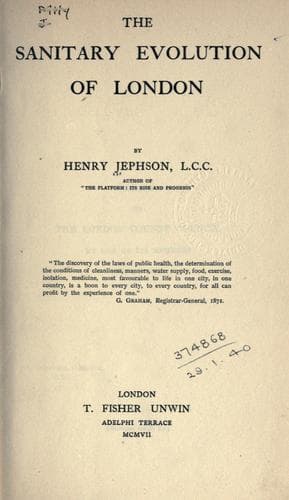
The Sanitary Evolution of LondonJephson, Henry (Henry Lorenzo)
History
The Sanitary Evolution of London
Jephson, Henry (Henry Lorenzo)
Public health -- England -- London
One other Act[171] deserves mention before the close of this decade
as it contained an unique section which required the Medical Officer
of Health, on notice from the owner of property in which there are
separate dwellings let for 7s. 6d. or less a week, to visit them and
examine all their sanitary arrangements, &c., so as to be able to
certify or not--
"That the house is so constructed as to afford suitable accommodation
for each of the families or persons inhabiting it, and that due
provision is made for their sanitary requirements."
The certificate, if granted, was to be handed to the owner, who was
then able to obtain the remission of the inhabited house duty.
The owner, therefore, obtained a remission of taxes to which he was
justly liable, because the dwelling which he lets was in a sanitary
condition!
In many ways, then, the sanitary evolution of the great city was
developing satisfactorily, though by no means so rapidly as was to be
desired, or as it might have developed if local governing authorities
had done their duty.
"The war of the community against individuals for the public good,"
which had now lasted for over thirty years, and the war against
disease in its most dangerous forms, was being waged with good effect;
and though an immensity remained to be done, a great deal had been
accomplished. Larger numbers of all classes were beginning to grasp the
idea and to realise that the necessity of securing and guarding the
public health was not a craze or form of mental aberration, but was of
absolutely vital consequence, not merely to certain classes but to the
great community of the metropolis and to the nation itself, and that
the future welfare and power, even the very existence, of the nation
are dependent upon it.
Larger numbers, too, were beginning to see who really were responsible
for the widely prevalent evils, and who really were obstructing
progress towards a higher standard of public health, and how little
claim they had to consideration, either from the hands of the
Legislature or of local administrators.
The reports of the Medical Officers of Health of the latter part of
this decade were distinctly more hopeful in tone, and recorded more
progress than ever before.
The catalogue of things in which improvement had taken place had
lengthened--sewerage, water supply, the removal of refuse, paving,
the regulation of offensive businesses, of cowhouses, dairies, and
bakehouses, the provision of open spaces, the better disinfection of
houses and of infected articles, the erection of hospitals for the
isolation of cases of infectious diseases--all of which things were
elemental necessaries if the public health was to be assured.
In some parishes, in place of the smaller class of houses, great blocks
of artizans' dwellings had been erected. In others great blocks of
flats.
Public-domain text, read in full here on John Shaqi.
Reviews
Reviews
No reviews yet
Be the first to share your thoughts on this work.
Elsewhere in the archive
Join the Discussion
Join the discussion
Sign in to leave a comment or review.
Sign InorCreate an account