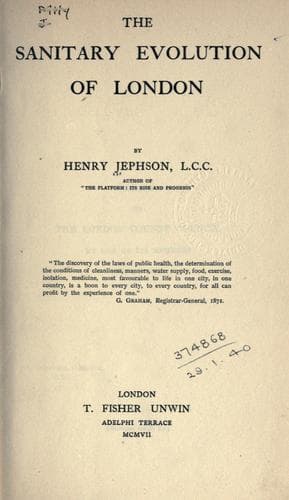
The Sanitary Evolution of LondonJephson, Henry (Henry Lorenzo)
History
The Sanitary Evolution of London
Jephson, Henry (Henry Lorenzo)
Public health -- England -- London
The _Lancet_ of January, 1887, stated that, measured by its recorded
death-rate, London was healthier in 1887 than in any year on record.
In the Strand in 1886:--
"The efforts that have been made by the Board and its officers have
resulted in a marked and continuous improvement in the sanitary state
of the district."
In St. Pancras in 1888 the death-rate was "by far the lowest yet
recorded."
In Bermondsey, in the same year, "so few deaths have not occurred since
1865."
These and similar reports from other districts showed that sanitary
progress was being made. But, unfortunately, in the autumn of 1888
there was an epidemic of measles of exceptional severity, which raised
the death-rate. And in 1890 there was a sudden increase from 18·4 per
1,000 to 21·4, a mortality which was higher than any since 1882.
The increase served to show the great necessity there was for unceasing
watchfulness and for steady perseverance in sanitary work. The forces
of disease are ever on the watch for the opportunity to work their evil
will, and there were still many weak places in the defences against
them. The central government of London had been improved enormously,
but the corrective was not extended to where it was most wanted,
namely, the local Sanitary Authorities, the Vestries and District
Boards.
FOOTNOTES:
[149] To the then existing population of London.
The South Eastern Counties contributed close on 290,000
" South Midland " " " " 249,000
" Eastern " " " " 196,000
" South Western " " " " 168,000
" West Midland " " " " 95,000
[150] The report was made in 1887, but was as true in 1881 as it was
in 1887.
[151] See Report of Select Committee, 1882, p. v.
[152] _Times_, 20th November, 1883.
[153] See his speech in Parliament, Hansard, 1884, vol. ccxc., p. 529.
[154] Robert Reid (a Surveyor), p. 805.
[155] The regulations suggested by the Local Government Board laid down
that the landlord or owner should not allow a greater number of persons
to occupy a room than would admit of free air space for each of 300
cubic feet--if used exclusively as a sleeping room--or 400 feet if used
day and night.
He was to--
(1) Keep the drainage in good working order, to properly pave the
yard, and provide sufficient sanitary accommodation.
(2) Keep the cisterns clean and in proper order, and keep the
structure of ashpit in proper order.
(3) Cause the ceilings and walls of every room to be whitewashed
and papered every April.
(4) Provide all requisite means for the ventilation of every room,
and of the common passages and staircases thereof.
(5) To notify cases of infectious disease.
[156] Royal Commission, 1884.
[157] Hansard, 1884.
[158] 1884 Royal Commission, vol. ii. p. 2938.
[159] Ibid. p. 724.
[160] Hansard, 1884, vol. cclxxxix. p. 41.
[161] Hansard, 1884, vol. ccxc. p. 541.
Public-domain text, read in full here on John Shaqi.
Reviews
Reviews
No reviews yet
Be the first to share your thoughts on this work.
Elsewhere in the archive
Join the Discussion
Join the discussion
Sign in to leave a comment or review.
Sign InorCreate an account