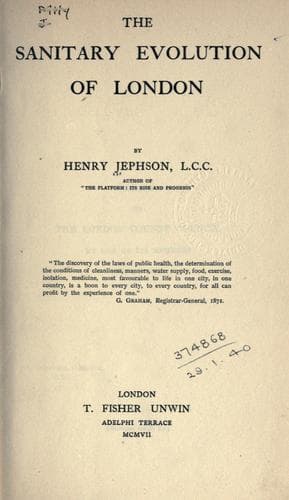
The Sanitary Evolution of LondonJephson, Henry (Henry Lorenzo)
History
The Sanitary Evolution of London
Jephson, Henry (Henry Lorenzo)
Public health -- England -- London
[162] See Report of Royal Commission on the Amalgamation of the City
and County of London, 1894.
[163] Hansard, 1884, vol. cclxxxiv.
[164] By the Diseases Prevention (Metropolis) Act, 1883, 46 and 47 Vic.
cap. 35.
[165] The total net expenditure was £401,000 in 1885.
[166] Hansard, vol. ccxxix. p. 889.
[167] Lords' Committee on Sweating, P.P. 1890, vol. 17.
[168] Hansard, p. 1663, March 19, 1888.
[169] See the last Report of the Board.
[170] 53 & 54 Vic., cap. 70.
[171] The Customs and Inland Revenue Act, 1890, 53 & 54 Vic. cap. 8.
[172] See speech by Sir L. Playfair in House of Commons, March 4,
1884.--Hansard, p. 529.
[173] See Report from Royal Commission on Tuberculosis, 1898.
CHAPTER VI
1891-1901
IN 1891 the census once more gave authoritative figures as to the
population of the metropolis of London. The population had increased
from 3,830,297 to 4,228,317.
The increase had been in a somewhat lower ratio than the population of
England and Wales as a whole, and the fact was notable inasmuch as it
was the first time that such a phenomenon had presented itself, London
having been found in every preceding intercensal period to have gained
more or less in its proportions as compared with the country at large.
The movements of population had followed very much the same lines as in
the previous decade. In the central parts--under the pressure of the
great economic forces--the population had increased. In the outer parts
it had increased, but "the wide belt of suburbs was beginning to show
some signs of repletion."
Immigration into London had greatly diminished in the decade. Fewer
immigrants had come from the various counties of England and Wales, and
the proportion of the inhabitants of London who had been born elsewhere
had fallen from 308 persons per 1,000 in 1881 to 283 in 1891.
Thus the influx of country people, mostly in the prime of life, and the
admixture of fresh country blood into the urban population of London
was undergoing diminution--a circumstance which, in the long run, would
materially influence the physique of the people.
Three important facts came into view with the figures set out in the
census, giving food for thoughtful minds as regarded the future of
London.
The first was that the rate of increase of the population had again
slackened off. The flood tide of population was not now flowing so fast.
The second was that the population was being affected by migration.
The natural increase of the population had been 510,384, the actual
increase 396,199--so that London had lost by the excess of emigration
over immigration more than 114,000 persons. This was the first time
such an event had happened.
Public-domain text, read in full here on John Shaqi.
Reviews
Reviews
No reviews yet
Be the first to share your thoughts on this work.
Elsewhere in the archive
Join the Discussion
Join the discussion
Sign in to leave a comment or review.
Sign InorCreate an account