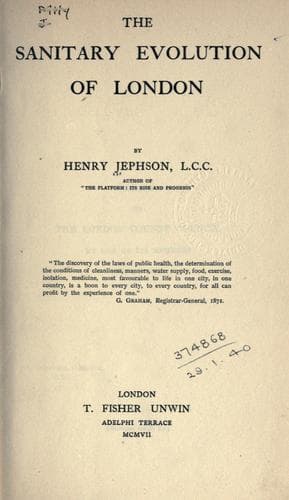
The Sanitary Evolution of LondonJephson, Henry (Henry Lorenzo)
History
The Sanitary Evolution of London
Jephson, Henry (Henry Lorenzo)
Public health -- England -- London
One gets a clue to the unceasing insanitary condition of the greater
part of London and to the inhuman conduct of so many tenement
house-owners when one realises that there was no legal punishment
whatever for the perpetration and perpetuation of the insanitary
abominations, no matter how noxious or dangerous they were, nor how
rapidly or directly they led to disease or death. An order to abate
a nuisance (which usually was not obeyed) appears to have been the
only penalty, and it was only obtainable at great trouble and after
great delays; and, even if obtained and the nuisance abated, there
was nothing to prevent the offender at once starting the nuisance
again. Offences of the most heinous description--amounting morally to
deliberate murder--were perpetrated with absolute impunity. Houses
which were scarcely ever free from fever cases were allowed to continue
year after year levying their heavy death tax from the unfortunate
inhabitants.
In Whitechapel one house, inhabited by twelve or fourteen families, was
mentioned as scarcely free from fever cases for as many years.
"It is also a fearful fact that in almost every instance where patients
die from fever, or are removed to the hospital or workhouse, their
rooms are let as soon as possible to new tenants, and no precautions
used, or warning given; and in some houses, perfect hotbeds of fever
probably, where a patient dies or is removed, the first new-comer is
put into the sick man's bed."
Sanitary improvement was almost a hopeless task. There was a dead
weight of opposition to it in the ignorance and recklessness and
indifference of the poorer classes, the very hopelessness of being
able to improve their condition. And there was an active and bitter
opposition from those house-owners or lessees who for their own
financial profit exploited the poorer classes.
"There is one house in Spitalfields," said Dr. Lynch, "which has been
the constant habitation of fever for fifteen years. I have enforced
upon the landlord the necessity of cleansing and lime-washing it, but
it has never been done!!... There are many landlords with whom nothing
but immediate interest has any effect."[24]
The favourite principle that an Englishman's house was his castle
was used as a defence against any suggestion that the malpractices
committed therein should be curbed.
Others argued, "I am entitled to do what I like with my own."
"We everywhere find people ready to declare in respect to every
evil: There is not any law that could compel its removal, the place
complained of being private property."
All sorts of far-fetched and strained arguments were devised by them in
the efforts to evade responsibility for the infamous condition of their
property, and to defend and justify inaction.
Fortunately some voices began to be raised as to the persons upon whom
both equitably and morally the responsibility lay of improving the
condition of things.
Public-domain text, read in full here on John Shaqi.
Reviews
Reviews
No reviews yet
Be the first to share your thoughts on this work.
Join the Discussion
Join the discussion
Sign in to leave a comment or review.
Sign InorCreate an account