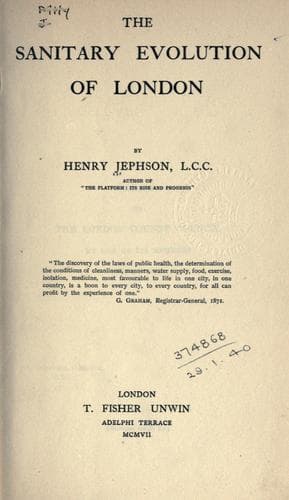
The Sanitary Evolution of LondonJephson, Henry (Henry Lorenzo)
History
The Sanitary Evolution of London
Jephson, Henry (Henry Lorenzo)
Public health -- England -- London
Also "the mortality returns were not kept in such a manner as to lead
to accuracy, for while all deaths of non-residents were excluded, the
deaths of residents dying outside the district in similar institutions
were not included.
"It is impossible to make an accurate statement as to the correct
meaning of the mortality returns--the returns are erroneous."
A similar miscalculation was made by the Vestry of St. George, Hanover
Square. In their report for 1890-1 they stated that they had no reason
to believe that the population was much different from what it was in
1871 and 1881. The census, however, showed that it had fallen over
11,000.
In each successive census the number of inhabited houses in London was
enumerated. In this one the number was 547,120--being an increase of
nearly 60,000; but not much instruction was to be obtained from such
general figures beyond the fact that houses were becoming more and more
densely packed.
The substitution of blocks of dwellings for small houses had also made
considerable progress during the intercensal period.[174]
The same reasons as to the diminution of the number of houses in the
central parts of London continued to be given by Medical Officers of
Health.
In St. George-in-the-East it had been brought about "by the extension
of warehouses and the demolition of insanitary property." In St.
Martin-in-the-Fields it was "due to many former residents having
removed to the country, and to the demolition of so many houses for
improvements." In the Strand to the fact that the district was becoming
like all the central parts of London, "a business, as distinguished
from a residential district." The Vestry of St. James' reported that
"buildings formerly occupied as dwellings were being replaced by
warehouses and business premises commanding a higher rent. As the
centre of trade extends, this condition of things must be expected to
continue, just as the increasing volume of trade has converted the City
of London at night from a populous place to little more than a city of
caretakers," and they drew attention to the "enormous number of people
engaged in business in the parish during the day time who resided
elsewhere."
On the south side of the river the same story was told. The Medical
Officer of Health for Lambeth remarking in his report that--
"The displacement of population from the central districts of Lambeth,
and the settlement of population in those districts which are situated
in the outer ring, or on the circumference of the inner, is a part of a
greater movement which affects the whole metropolitan area."
The census of 1891 is specially memorable by the fact that for the
first time a mass of most valuable information was obtained which was
wholly new, and which threw a blaze of light upon the condition of the
housing of the population of London.
Public-domain text, read in full here on John Shaqi.
Reviews
Reviews
No reviews yet
Be the first to share your thoughts on this work.
Elsewhere in the archive
Join the Discussion
Join the discussion
Sign in to leave a comment or review.
Sign InorCreate an account