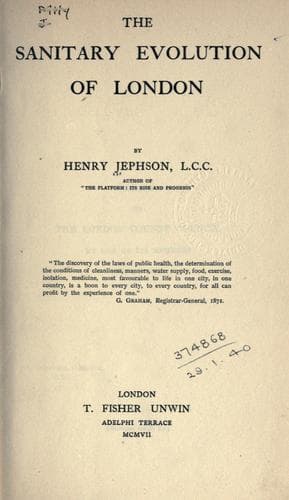
The Sanitary Evolution of LondonJephson, Henry (Henry Lorenzo)
History
The Sanitary Evolution of London
Jephson, Henry (Henry Lorenzo)
Public health -- England -- London
London's boundaries, however, were very arbitrary and haphazard, and
this emigration was probably only to places immediately outside London
for residence at night, whilst work was performed in London during
the day--as illustrated by the "City" and the Strand, where huge
differences existed between the day and night populations. The figures
showed, however, a movement of population which was bound to have an
effect upon the sanitary condition of the people.
A third and portentous fact, ascertained correctly by aid of the census
figures, was the decline of the birth-rate in London. This had fallen
remarkably since 1881. It was then 34·7 per 1,000 living. It was now
31·9.
Deducible from the census figures, reliable calculations could also be
made as to the death-rate in the metropolis.
In 1891 it was practically the same as in 1881, being 21·4 per 1,000.
It might be inferred that these latter figures did not afford much
testimony to the effects of sanitary administration and labours, but
the pause in the steady decline was only a temporary one.
The authoritative and accurate records thus afforded decennially
by the census are invaluable in tracing some of the most important
developments in the sanitary evolution of London.
Another very noteworthy change was also brought into prominence by
the census. This was the continued rapid growth of the population
immediately outside the boundaries of the County of London.
Between 1871 and 1881 it had increased 312,000. Between 1881 and 1891
it had increased by 469,000, and now in 1891 it stood at 1,405,000,
having more than doubled since 1871.
A passage in the report of the Medical Officer of Health for Islington
in 1895 illustrates this so far as his own district was concerned:--
"The fact cannot be burked that many of the better classes have gone
further into the country to live, induced to do so by the increased
facilities for travelling that railways have provided.... The same
facilities have also checked the influx of people to the same extent as
formerly, so that now in northern London people are flocking to Hornsea
and Hampstead and thereaway."
The fact was that the metropolis had burst its boundaries, and just as
it had grown up around the "City" so now the "outer ring," as it was
called, was growing up around it.
How little reliance could be placed on the intercensal estimates of
Medical Officers of Health as to the number of inhabitants and the
death-rate, is illustrated by the following passage from the report of
the Medical Officer of Health for Islington in 1891:--
"There was an error amounting to nearly 50,000 in the estimated
population of the parish in 1891; consequently all statistics based
on the estimated figures during the decade 1881-91 are more or less
erroneous."
Public-domain text, read in full here on John Shaqi.
Reviews
Reviews
No reviews yet
Be the first to share your thoughts on this work.
Elsewhere in the archive
Join the Discussion
Join the discussion
Sign in to leave a comment or review.
Sign InorCreate an account