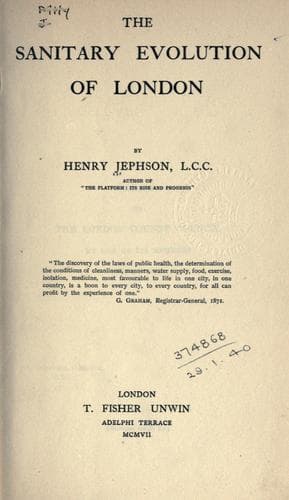
The Sanitary Evolution of LondonJephson, Henry (Henry Lorenzo)
History
The Sanitary Evolution of London
Jephson, Henry (Henry Lorenzo)
Public health -- England -- London
Of still deeper interest and import was the information obtained as to
that dreadful factor in London life--"overcrowding." An effort was now
for the first time made to get reliable information upon this matter.
Hitherto it was only by piecing together the statements made by some of
the Medical Officers of Health as to overcrowding in their respective
parishes that one could form even the crudest idea of what the sum
total in London actually amounted to.
Here, at last, was material enabling accurate calculations to be made,
not only of overcrowding in each separate parish or district, but in
London as a whole.
The Census Commissioners laid down the principle--
"That ordinary tenements which have more than two occupants per room,
bedrooms and sitting-rooms included, may be considered as unduly
overcrowded.
"We may," they wrote, "be tolerably certain that the rooms in tenements
with less than five rooms will not in any but exceptional cases be
of large size, and that ordinary tenements which have more than two
occupants per room, bedrooms and sitting-rooms included, may safely be
considered as unduly overcrowded."
By using the information given in the tables, and excluding all
one-roomed tenements with not more than two occupants, all two-roomed
tenements with not more than four occupants, all three-roomed tenements
with not more than six, and all four-roomed tenements with not more
than eight occupants, the desired information would be obtained. And
they added:--
"Each Sanitary Authority is now provided with the means of examining
with much precision into the house accommodation of its district."
Provided with the tables as to the occupants of tenements, the Medical
Officer of Health for the London County Council, in his report for
1891, worked out the figures for the metropolis. The result showed that
there were in London 145,513 tenements of less than five rooms apiece,
in each of which there were more than two inhabitants per room, and
each of which consequently was "overcrowded."
But it is when one ascertains the number of persons living in these
overcrowded tenements that one realises what the extent of overcrowding
was. In round numbers, one-fifth of the entire population of London
lived in these tenements. The total population was 4,200,000; the
number of "overcrowded" persons was 830,000.
A few illustrations of the overcrowding in certain parishes brings the
meaning of these figures home still more.
In Clerkenwell, 25,600 persons lived in overcrowded tenements; in St.
Luke, 18,700 persons; in Shoreditch, 41,700; in Islington, 64,600; in
Kensington, 28,700; in Lambeth, 43,600. The larger proportion of these
lived in one- or two-room tenements.
Public-domain text, read in full here on John Shaqi.
Reviews
Reviews
No reviews yet
Be the first to share your thoughts on this work.
Elsewhere in the archive
Join the Discussion
Join the discussion
Sign in to leave a comment or review.
Sign InorCreate an account