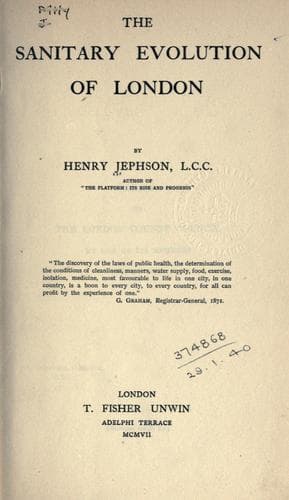
The Sanitary Evolution of LondonJephson, Henry (Henry Lorenzo)
History
The Sanitary Evolution of London
Jephson, Henry (Henry Lorenzo)
Public health -- England -- London
Figures are dry things to read and difficult to understand. To
appreciate the true meaning and import of these, and to enable one
who reads them to at all realise the conditions of existence of
these hundreds of thousands of people, one must recall to mind the
descriptions given by many of the Medical Officers of Health of
tenement-houses; of all the misery, the filth, the sickness, the
physical and moral degradation of life in tenement-rooms.
These facts now for the first time revealed the full magnitude and
momentous nature of the problem of the sanitary housing of the people.
The year 1891 is memorable in the history of the sanitary evolution
of London for "the Public Health (London) Act, 1891,"[175] which
consolidated and amended the laws then existing in connection with the
public health of the metropolis.
The state of the law was recognised as very unsatisfactory, being
scattered over some thirty statutes or more--a condition of things
which was greatly to the disadvantage of the public health of London.
Moreover, in accordance with the extraordinary custom, London, which on
account of its huge population needed sanitary legislation almost more
than any other place, had been excepted from much sanitary legislation
which had been in operation for many years, with the most beneficial
results, in the remainder of the country. Part of this legislation
was at long last extended to London. Many amendments were made,
recommendations of the Royal Commission of 1884 were given effect to,
new provisions introduced, and the general result was a Sanitary Code
for London--imperfect still in some important respects, but a great
advance on anything which London had previously possessed.
The Act came into operation on the 1st of January, 1892, and it applied
to the Administrative County of London only; some few of the provisions
extending to the "City."
And for the first time the new Central Authority--the County
Council--with extended powers, occupied a prominent place in this
legislation.
Once more did Parliament enact the oft-ignored direction that "it
shall be the duty of every sanitary authority to cause to be made
from time to time inspection of their district" for detection of
nuisances--a duty so shamelessly neglected--and "to put in force the
powers vested in them relating to public health and local government
so as to secure the proper sanitary condition of all premises in their
district."
With a view to secure fit and proper persons as Medical Officers of
Health and Sanitary Inspectors, their appointment was made subject to
the regulations of the Local Government Board.
Public-domain text, read in full here on John Shaqi.
Reviews
Reviews
No reviews yet
Be the first to share your thoughts on this work.
Elsewhere in the archive
Join the Discussion
Join the discussion
Sign in to leave a comment or review.
Sign InorCreate an account