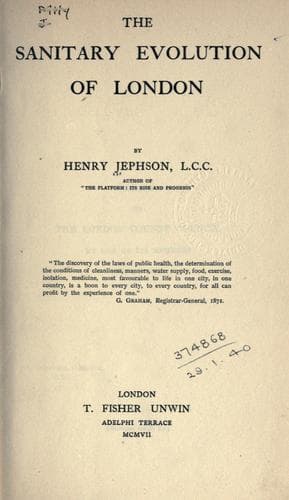
The Sanitary Evolution of LondonJephson, Henry (Henry Lorenzo)
History
The Sanitary Evolution of London
Jephson, Henry (Henry Lorenzo)
Public health -- England -- London
The Act greatly strengthened the law both as to the prevention and
definition of nuisances. It provided for the immediate abatement of a
nuisance, not only where actually proved to be injurious or prejudicial
to health, but also where it was dangerous to health. It gave to any
person the right to give information of nuisances to the sanitary
authority instead of that right being limited to the person affected
by the nuisance; and it extended to a Sanitary Authority the power
to take proceedings for the abatement of nuisances arising in the
district of another authority should the nuisance injuriously affect
the inhabitants of their own district. It transferred from the police
to the local authority the enforcement of the provisions of the law
against smoke nuisances. It dealt with the removal of refuse. It
extended the previous laws as to the adulteration of food and drugs,
and the inspection of articles intended for the food of man. It enacted
that a newly-erected dwelling-house must not be occupied until a
certificate had been obtained of the Sanitary Authority to the effect
that a proper and sufficient supply of water exists; and made the
provisions as to the occupation of underground rooms as dwellings more
stringent and effective.
The notification and prevention of the infectious and epidemic
diseases, the provision of hospitals, ambulances, and many other
branches of the great subject--the health of the public--were
legislated upon. Additional duties were imposed on the Sanitary
Authority in the matter of disinfection; the practical result of
which was that the whole cost of disinfecting houses, and cleansing
and disinfecting bedding, clothing, &c., was thrown upon the rates.
In several matters the option given in previous legislation to local
authorities to administer the law was taken away, and the duty made
imperative. Parliament evidently had realised the hostility of many
of the Vestries to administering some of the principal provisions of
sanitary law, and the word "shall" figured much more frequently than
ever before.
The hitherto optional provision of mortuaries by the sanitary
authorities was made compulsory, the need for suitable and convenient
places for the reception of the dead during the time that bodies are
awaiting burial having long been felt, particularly in the poorer
districts, where bodies awaiting burial were of necessity frequently
kept in living rooms under conditions dangerous to health, especially
where the case was an infectious one.
Among these "shalls" was that most important of all health
subjects--overcrowding--and the condition of the tenement-houses of
London. In this matter the local authorities had through a quarter of a
century been tried in the balance and found wanting, and it was enacted
(Sec. 94):--
Public-domain text, read in full here on John Shaqi.
Reviews
Reviews
No reviews yet
Be the first to share your thoughts on this work.
Elsewhere in the archive
Join the Discussion
Join the discussion
Sign in to leave a comment or review.
Sign InorCreate an account