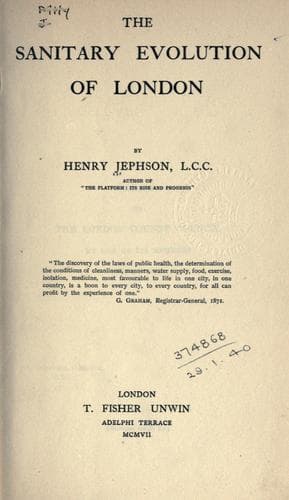
The Sanitary Evolution of LondonJephson, Henry (Henry Lorenzo)
History
The Sanitary Evolution of London
Jephson, Henry (Henry Lorenzo)
Public health -- England -- London
In order to remove doubts as to the Council's responsibilities as
to the administration of the law relating to epidemic diseases, a
provision defining the Council's position was included in the Council's
General Powers Bill, which was passed by Parliament in 1893. This
provision was to the following effect:--
"The Local Government Board may assign to the Council any powers and
duties under the epidemic regulations made in pursuance of Section 134
of the Public Health Act, 1875, which they may deem it desirable should
be exercised and performed by the Council.
"If the Local Government Board are of opinion that any sanitary
authority in whose default the Council has power to proceed and act
under the Public Health (London) Act, 1891, is making or is likely
to make default in the execution of the said regulations, they may
by order assign to the Council, for such time as may be specified in
the order, such powers and duties of the sanitary authority under the
regulations as they may think fit."
Parliament thus once more emphasised the policy of the local sanitary
authorities being subordinated to the Central Authority.
The new Central Authority--representative of the people of London--gave
early evidence of vitality and energy. The heir had come into his
property, with high ideals as to its government, and as to the
welfare of the people. A new power had suddenly been brought into
London life--an unknown but vigorous force. A capable staff was at
once organised, and a Medical Officer and Assistant Medical Officer
of Health appointed. Inquiries and investigations into the various
matters most concerning the welfare of the citizens of London were at
once undertaken, and conclusions arrived at, and action taken, with a
thoroughness and a rapidity hitherto unknown in the administration of
London affairs.
Bye-laws were made to regulate and unify the administration of sanitary
laws by local authorities.
Several of the water companies were induced to give a constant supply
of water to an increased extent.
And great efforts were made to utilise the powers conferred upon the
Council by the recently passed Acts--the Housing of the Working Classes
Act of 1890, and the Public Health (London) Act of 1891.
It was at once felt that the problem which first faced the Council was
the housing of the people, and the Council determined to attack it on
every side.
In the belief that facilities of communication between the working
centres of London and residences in healthier localities would help
considerably to alleviate some of the worst effects of overcrowding,
and towards the successful treatment of the great housing problem,
action was taken to turn the Cheap Trains Act of 1883 to greater
account, and to secure greater numbers of workmen's trains and more
moderate fares; so as to enable workmen to travel cheaply between more
distant homes and their places of employment.
Public-domain text, read in full here on John Shaqi.
Reviews
Reviews
No reviews yet
Be the first to share your thoughts on this work.
Elsewhere in the archive
Join the Discussion
Join the discussion
Sign in to leave a comment or review.
Sign InorCreate an account