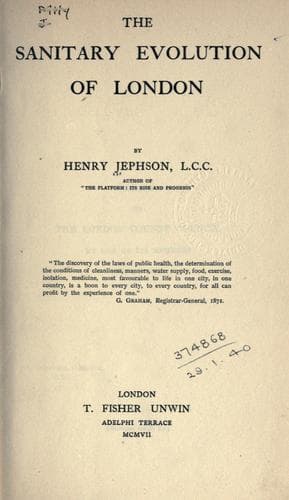
The Sanitary Evolution of LondonJephson, Henry (Henry Lorenzo)
History
The Sanitary Evolution of London
Jephson, Henry (Henry Lorenzo)
Public health -- England -- London
That Act, which gave a large remission in the amount of passenger duty
paid by railway companies, if the companies would provide a service
of workmen's trains, and would convey workmen at less than the usual
fares, had so far not been made much use of.
On investigation it was found that the facilities afforded to workmen,
particularly on certain railways, were very inadequate. There were no
workmen's trains at all on one important line--on another only one such
train was run, whilst on several others the number of trains run was
very small.
Representations were made to the Board of Trade and negotiations
carried on with the Railway Companies, and by degrees a considerable
extension of the facilities for the conveyance of workmen was secured.
The Council gave its immediate and more anxious attention to those
breeding-places and forcing-pits of disease and misery, the insanitary
areas in London.
The Housing Act of 1890 (by Part I.) constituted the Council the
authority for preparing and carrying into effect schemes for the
clearance and improvement of insanitary areas which were of such
size, and situation, and character, as to render their clearance and
reconstruction of general importance to the County.
The tremendous task of dealing with them was rendered more difficult
and costly by the obligation imposed by Parliament of providing housing
accommodation for the persons displaced; for in the lack of easy means
of communication with the outer parts of London it was held to be
necessary to re-house the greater number of them in the same locality.
The Metropolitan Board of Works had simply acquired and cleared the
properties, and disposed of the sites to companies or individuals,
placing on them the obligation to erect houses for the working classes.
Now, however, the Council determined itself to erect, let, and
maintain, the necessary dwellings. The chief reason for the change was
the difficulty experienced in finding companies or persons who were
willing to undertake the erection of dwellings on some of the sites.
The Council had to complete several schemes which it inherited in an
unfinished condition from the Metropolitan Board of Works, but it at
once initiated many itself, and carried them through to a successful
conclusion.
And as one after another of the insanitary areas was investigated, so
again and again was revealed to public view the appalling condition
in which thousands of people--in the very heart of London--dragged
out an existence more bestial than human; horrors piled on horrors--a
state of things all the more awful because it had been existing for an
indefinite number of years--levying annually the heaviest of tolls
on those who came within its deadly sphere, and scattering its poison
abroad among the community at large.
Public-domain text, read in full here on John Shaqi.
Reviews
Reviews
No reviews yet
Be the first to share your thoughts on this work.
Elsewhere in the archive
Join the Discussion
Join the discussion
Sign in to leave a comment or review.
Sign InorCreate an account