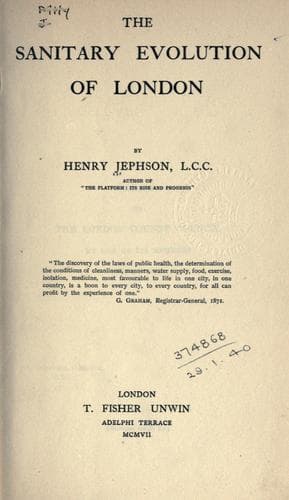
The Sanitary Evolution of LondonJephson, Henry (Henry Lorenzo)
History
The Sanitary Evolution of London
Jephson, Henry (Henry Lorenzo)
Public health -- England -- London
But another reflection also suggests itself, namely, why should the
ratepayers of London have been obliged to pay these high sums for
property which, by the culpable neglect of the owners and their
predecessors, had been allowed to sink into a condition not alone
exceptionally dangerous to the lives of its inhabitants, but a constant
danger to neighbouring districts--even to London itself. Surely in
common fairness, those who had let it fall into such a state should
have paid the penalty therefor, and not the public of London, who had
had no part in bringing the property into such an evil condition.
Part II. of the Act was mostly a consolidation of Torrens' Acts, 1868
and 1882, with amendments. It enabled the Vestries or District Boards
to take proceedings before a magistrate for the clearing and demolition
of single houses unfit for human habitation, and obstructive buildings,
and empowered them and the County Council to undertake schemes for the
improvement of areas too small to be dealt with by the Council.
The owner might elect to retain the site after the demolition of the
building, and in that case received compensation for the building only.
If the Vestry or District Board acquired the site the same procedure as
to compensation had to be followed as under Part I.
A few schemes were undertaken by Vestries under this Part of the
Act, the Council making a contribution to the cost, and a few by
the Council. Thus in St. George-in-the-East, from November, 1890,
to the end of 1894, 224 houses were "represented" as unfit for
habitation--gruesome pictures of dirt, dilapidation, and insanitation
of every form and variety, and this, too, after nearly forty years
of sanitary work by the Vestry. Many were closed by order of the
magistrate, some by the owner, some pulled down, some repaired and
re-let.
Part III. of the Act embodied the idea, originally started by Lord
Shaftesbury in 1851, as to the erection of labouring classes'
lodging-houses by the local authorities, and grafted several amendments
thereon.
Power was given for the acquisition by the Council of land for the
purpose of erecting lodging-houses thereon. Such land, however, was
to be within the Council's jurisdiction. Under this part of the Act
the Council erected a common lodging-house in Parker Street for the
accommodation of over 300 persons. It also acquired several sites,
including the Millbank estate, upon which it proceeded to build houses;
and one of 38 acres at Lower Tooting for the erection of cottages
thereon.
Altogether the work performed under the Act was considerable, and the
housing for the accommodation of the working classes made sensible
progress, the sites sold by the Metropolitan Board of Works to trusts,
and public companies, and private persons, having been built upon and
covered with artizans' dwellings.
Private building was proceeding at considerable pace, and in many parts
of London the ground was becoming more overcrowded than ever with
houses.
Public-domain text, read in full here on John Shaqi.
Reviews
Reviews
No reviews yet
Be the first to share your thoughts on this work.
Elsewhere in the archive
Join the Discussion
Join the discussion
Sign in to leave a comment or review.
Sign InorCreate an account