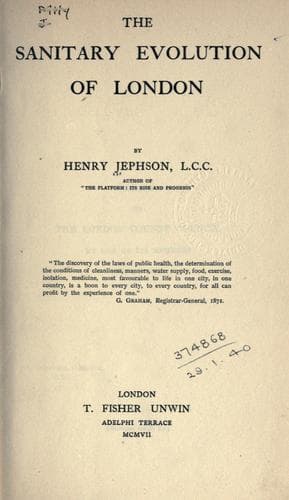
The Sanitary Evolution of LondonJephson, Henry (Henry Lorenzo)
History
The Sanitary Evolution of London
Jephson, Henry (Henry Lorenzo)
Public health -- England -- London
There was the Clare Market (Strand) Scheme, some 3-1/2 acres--3-1/2
acres of human wretchedness and disease and misery and filth. In
one sub-area there were upwards of 800 persons to the acre. Here
the death-rate was 41·32 per 1,000 in 1894; in another sub-area,
the death-rate had been 50·52 per 1,000 in 1893; the death-rate for
the whole area having been 39·03 in 1894. And in addition to this
was the unknown sick-rate. There was the Webber Row Scheme in St.
George-the-Martyr, Southwark--close upon 5 acres in extent, with a
death-rate of 30·5 per 1,000. There were the Roby Street and Baltic
Street areas in St. Luke, areas which "have about the worst reputation
of any in London."
The largest scheme which the Council undertook was that known as "the
Boundary Street Area" in Bethnal Green. Here some fifteen acres of
old, dilapidated, crowded dwellings--dwellings so insanitary that the
death-rate in them was over 40 per 1,000--were swept away, entailing
the displacement of 5,719 persons; and the ground so cleared was laid
out with wider streets, and a large open space and excellent buildings
were erected thereon to contain 5,524 persons without crowding. The
Prince of Wales once more testified his deep interest in the welfare
of the poorer classes of London by opening the new buildings--a
ceremony which took place on the 3rd of March, 1900--and delivering an
impressive speech.
A summary of the work accomplished by the Council up to this time
showed that the Council had provided, or was engaged in providing,
accommodation for 35,950 persons at a total outlay of close upon
£2,000,000, an amount of building operations which, if conducted at one
spot, would have resulted in the formation of a town of nearly 36,000
inhabitants.[176]
The cost of this work was enormously heavy, owing to the fact that the
arbitrator could and did award commercial value for the land; but, as
was pointed out by the Medical Officer of Health for the London County
Council[177]:--
"The primary object of Part I. of the Act is not to provide artizans'
dwellings, but to secure the removal from the midst of the community
of houses which are unfit for habitation, and the faults of which
are in large degree due to bad arrangement. Where houses are thus
situated, and are in a number of ownerships, rearrangement can only be
carried out by vesting the property in one ownership, that of a public
authority, who can then, by the making of new streets and by complete
rearrangement of the area, ensure that the conditions which in future
will exist are such as are needed for the health of the inhabitants.
The chief value of the Act is, therefore, not so much the provision of
house accommodation which is fit for habitation, as the abolition of
houses which are dangerous to health. Part I. is not, therefore, in
itself so much a Housing Act as an Act for the removal of nuisances on
a large scale."
Public-domain text, read in full here on John Shaqi.
Reviews
Reviews
No reviews yet
Be the first to share your thoughts on this work.
Elsewhere in the archive
Join the Discussion
Join the discussion
Sign in to leave a comment or review.
Sign InorCreate an account