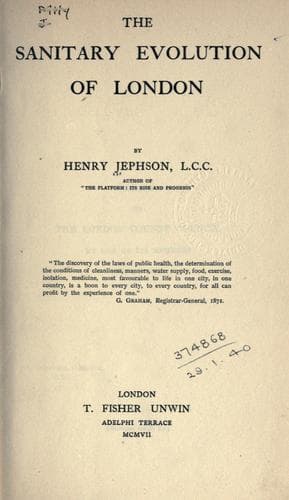
The Sanitary Evolution of LondonJephson, Henry (Henry Lorenzo)
History
The Sanitary Evolution of London
Jephson, Henry (Henry Lorenzo)
Public health -- England -- London
In the earlier stages of the reform of the housing of London such
buildings had been acclaimed as great improvements, as indeed they
were. The later opinions of Medical Officers of Health were not
so laudatory. Thus, in 1891, the Medical Officer of Health for
Whitechapel, after stating that there were in his district 27 buildings
having 3,127 apartments containing 12,279 persons, added that he was
"not enlisted amongst the enthusiasts of this method of providing for
the housing of the working classes." In 1896 he wrote: "All model
dwellings are not equally models of good sanitary houses." And in
1897:--
"The increased population are housed in huge barrack buildings which
sometimes are constructed so as to allow light and air to permeate the
rooms and sometimes not. The effect of this modern invention is to
increase the density of population to a damaging degree....
"That the direct influence of these barrack buildings upon the health
of their occupants--more especially the children--is adverse, I have
not the slightest doubt."
The Vestry of Shoreditch reported in 1892-3:--
"'Model Artizans' Dwellings' do not appear to have been quite what
their title implied. At Norfolk Buildings, Shoreditch, on the Medical
Officer of Health causing them to be examined for a certificate for
exemption from the inhabited house duty, the whole system of drainage
was found to be in a most defective and dangerous state. A number of
cases of typhoid, diphtheria, and other infectious illness had occurred
on the premises."
And a couple of years later the Chief Sanitary Inspector submitted to
his Vestry a report on some so-called "model dwellings": "These blocks
of buildings, 50 feet high, are packed together so as to exclude light
and air, and four rooms occupy the site of two: evil conditions which
the architect and owner were not only privileged to create, but also,
and very practically, in so doing were they privileged to condemn
unborn generations of people, whose necessities condemn them to live in
these tenements, to endure the evils of their creation."
The Medical Officer of Health for St. James' wrote:--
"Block dwellings in such an area as St. James' do not provide the
conditions in which healthy children can be reared, nor in which there
can be a family life comparable with that possible in the open suburbs
of London."
The Medical Officer of Health for St. Olave gave a description of
Barnham Buildings:--
"Many of the rooms, &c., on the ground and first floor are generally
very dark, and the buildings have not been maintained in a sanitary
condition, notwithstanding the hundreds of notices that have been
served the past five years. The average death-rate of the past five
years of the unhealthy tenements was at least 49·6 per 1,000 and of the
remainder at least 29·1."
The Medical Officer of Health for St. Marylebone gave an interesting
explanation of the condition of this class of houses:--
Public-domain text, read in full here on John Shaqi.
Reviews
Reviews
No reviews yet
Be the first to share your thoughts on this work.
Elsewhere in the archive
Join the Discussion
Join the discussion
Sign in to leave a comment or review.
Sign InorCreate an account