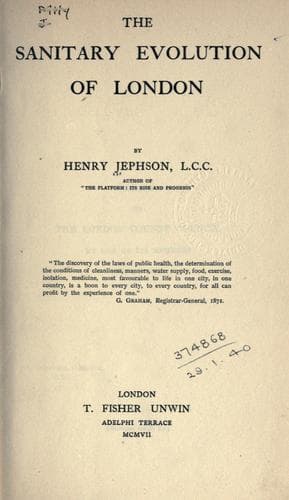
The Sanitary Evolution of LondonJephson, Henry (Henry Lorenzo)
History
The Sanitary Evolution of London
Jephson, Henry (Henry Lorenzo)
Public health -- England -- London
"The following is a list of applications, under the Customs and
Inland Revenue Act, 1891, from which it will be gathered that it is
quite exceptional for a block of artizans' dwellings of even recent
construction to be in a tolerable sanitary condition. The reason for
this anomalous state of things is, that in the building of these
dwellings the Sanitary Authority seems to have no power; a dwelling
must be occupied before it comes under supervision."
In spite of these and many other drawbacks, however, many of these
buildings afforded accommodation far superior to that which had
previously existed on the spots where they were erected, and provided
residence for large numbers of people who otherwise might have been
doomed to living in the worst class of tenement-house.
Closely connected with the Public Health Act of 1891 was another Act
passed in the same year--"The Factory and Workshop Act."
The Select Committee of the House of Lords on the Sweating System had
finished their inquiry and reported in 1890. The evidence given before
it was, as regarded factories, workshops, and workplaces, very much a
repetition of that which for thirty-five years had been detailed by
Medical Officers of Health as regarded the dwellings of the people, but
now obtaining greater publicity attracted more attention.
Overcrowding and insanitation of almost every conceivable kind pursued
large numbers of the unfortunate workers from their overcrowded and
insanitary tenements to their overcrowded and insanitary workplaces,
and with the same disastrous results. And as regarded domestic
workshops the conditions were even worse, workers spending their days
and nights often in the one room--sometimes with extra workers brought
in.
Want of light and air and overcrowding in workshops and factories are
quite as serious matters as they are in inhabited houses.
The Select Committee, in their conclusions and recommendations, said:--
"The sanitary conditions under which the work is conducted are not only
injurious to the health of the persons employed, but are dangerous to
the public, especially in the case of the trades concerned in making
clothes, as infectious diseases are spread by the sale of garments
made in rooms inhabited by persons suffering from smallpox and other
diseases. Three or four gas jets may be flaring in the room, a coke
fire burning in the wretched fireplace, sinks untrapped, closets
without water, and altogether the sanitary condition abominable."
"A witness told us that in a double room, perhaps nine by fifteen feet,
a man, his wife, and six children slept, and in the same room ten men
were usually employed, so that at night eighteen persons would be in
that one room."
Public-domain text, read in full here on John Shaqi.
Reviews
Reviews
No reviews yet
Be the first to share your thoughts on this work.
Elsewhere in the archive
Join the Discussion
Join the discussion
Sign in to leave a comment or review.
Sign InorCreate an account