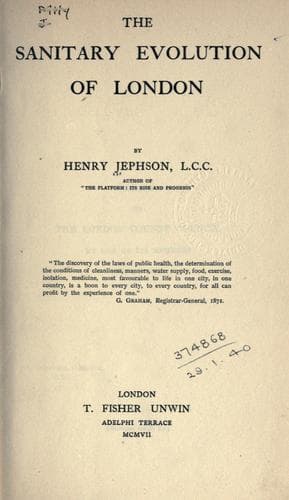
The Sanitary Evolution of LondonJephson, Henry (Henry Lorenzo)
History
The Sanitary Evolution of London
Jephson, Henry (Henry Lorenzo)
Public health -- England -- London
"The design and object of this Bill is to bring all workshops and
all factories up to the same sanitary level, and to require the
same conditions as to ventilation, overcrowding, lime-washing, and
cleanliness to be applied to all kinds of workshops in which men alone,
or women, children, and young persons are employed. The Bill does not
deal with 'domestic workshops.' The President of the Local Government
Board will introduce a Bill dealing with the public health, and the
House may rest content with leaving what is called 'the domestic
workshop'--that is to say, the working-man's home in which he works
with the members of his family--subject to the provisions of the law of
public health alone. It is obvious that in the domestic workshop you
have not got the presence of the employer and the employé. You have
the members of the same family ... and it seems to me that we may
allow him and his family to work in a place which is sufficiently good
so far as sanitary conditions are concerned for him and his family
to live in. Now that we are extending the sanitary provisions of the
Factory Act to all workshops throughout the country, of whatever kind
they may be except the domestic workshop, so that every cobbler's
shop, every blacksmith's shop, every tailor's shop, will come under
the provisions of the sanitary law, it seems to me foolish not to take
advantage of the existing machinery provided by the local authorities,
and the enforcement of the sanitary provisions, so far as workshops are
concerned, is by this Bill given to the local authorities."
The passing of the Factory and Workshops Act (1891) and of the Public
Health (London) Act of 1891 made the sanitary authorities primarily
responsible for enforcing many new provisions. Those authorities were
charged with the duty of securing the maintenance of the "workshops"
in a sanitary condition, of preventing overcrowding in them, and
of enforcing cleanliness, ventilation, lime-washing, and freedom
from effluvia, and securing the provision of sufficient sanitary
accommodation.
Added to this was the sanitary supervision of the places of
"outworkers."[179]
It would appear, however, that only in exceptional instances was any
systematic attempt made in 1892 to carry out the new duties imposed by
the Legislature upon the Vestries and District Boards.
In several instances the Medical Officers of Health drew attention
to the impossibility of undertaking workshop inspection with their
existing staff. Thus the Medical Officer of Health of Hackney:--
"Inquiry has revealed the presence of something like 2,000 workshops
and dwellings of outworkers which, under this Act and Order, should
be inspected to ascertain the presence or otherwise of any insanitary
condition. With the present staff it is impossible that this can be
attempted."
Public-domain text, read in full here on John Shaqi.
Reviews
Reviews
No reviews yet
Be the first to share your thoughts on this work.
Elsewhere in the archive
Join the Discussion
Join the discussion
Sign in to leave a comment or review.
Sign InorCreate an account