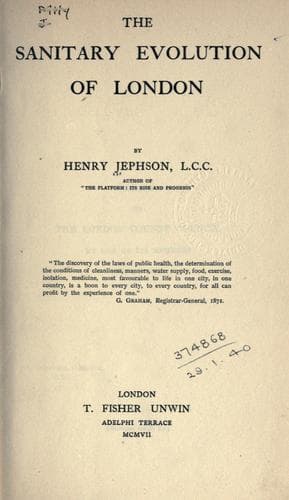
The Sanitary Evolution of LondonJephson, Henry (Henry Lorenzo)
History
The Sanitary Evolution of London
Jephson, Henry (Henry Lorenzo)
Public health -- England -- London
"In nine cases out of ten the windows are broken and filled up with
canvas; ventilation is impossible and light insufficient--the workshops
are miserable dens. We are of opinion that all workplaces included in
the above description should be required to be kept in a cleanly state,
to be lime-washed or washed throughout at stated intervals, to be kept
free from noxious effluvia, and not to be overcrowded--in other words,
to be treated for sanitary purposes as factories are treated under the
factory law."
Lord Kenry, Chairman of the Committee, in his draft report, said:--
"It has been shown that the dwellings or shops in which the sweated
class live and work are too often places in which all the conditions
of health, comfort, and decency are violated or ignored.... Sanitary
inspection is totally inadequate, and the local bodies have seldom
done their duty effectually. At the East End of London generally the
sanitary state of homes and shops could not possibly be much worse than
it is."
And Mr. Lakeman (Government Inspector under the Factories and Workshops
Act) said, in reference to workshops: "I think that the evidence given
your Lordships upon the insanitary state of those places is not at all
too black."
Once more the necessity of inspection was insisted upon. "On no point,"
wrote the Chairman, "was the unanimity of witnesses more emphatic than
with reference to the necessity of more efficient sanitary inspection,
not only of workshops, but of the dwellings of the poor."
And just as it was as regarded tenement-houses, inspection here was
lamentably deficient, if not absolutely non-existent.
"The inspection at present carried on is totally inadequate,
and nothing was more clearly proved before us than the fact that
satisfactory results cannot be looked for from the system as it now
stands."[178]
"Even when an unmistakable cause of unhealthiness is discovered, and
steps are taken to remove it, the process of applying the remedy is
slow and uncertain. The Local Board meets once a week or fortnight ...
the landlord is allowed a fortnight to carry out the work; three weeks
may elapse before the inspector can go and see it, then perhaps nothing
has been done; the summons, &c., takes time. In any case much valuable
time is lost, and smallpox or fever is allowed to pursue its ravages
with the source of the disease daily aggravated in intensity.
"At present the inspectors under the Factory and Workshop Act of 1878
have no power to deal with any nuisance which lies within the district
over which the local authorities preside. On the other hand, the local
inspector cannot interfere should he discover any breach of the Factory
Act."
The Home Secretary, in moving the second reading of the Bill, explained
its scope. He said:--
Public-domain text, read in full here on John Shaqi.
Reviews
Reviews
No reviews yet
Be the first to share your thoughts on this work.
Elsewhere in the archive
Join the Discussion
Join the discussion
Sign in to leave a comment or review.
Sign InorCreate an account