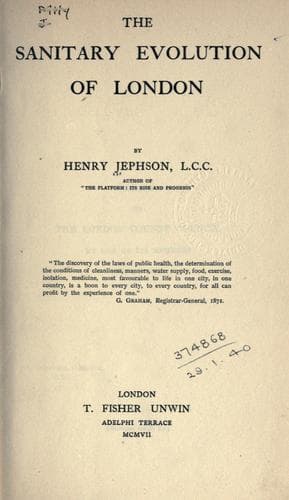
The Sanitary Evolution of LondonJephson, Henry (Henry Lorenzo)
History
The Sanitary Evolution of London
Jephson, Henry (Henry Lorenzo)
Public health -- England -- London
The mileage of public streets to be paved, lighted, cleansed, and
watered, had multiplied two, three, and four times since 1855; the
number of houses in many districts had more than doubled; the drainage
work had increased proportionally; the scavenging and removing of
refuse also. Nominal duties had become real ones, and new duties had
been added--the disinfection of infected houses and infected clothes,
the inspection of food, the working of the Food and Drugs Act--these,
with numerous smaller matters, meant a very considerable amount of
work, expense, and responsibility.
But all these were what one of the Vestries in their Report described
as "well-worn grooves of familiar routine." In addition thereto,
and now more than ever of primary importance, was the great duty of
inspection--inspection of houses, and of rooms in houses, and of
workshops, and often the consequent proceedings for the abatement of
nuisances, or the punishment of offenders.
"House-to-house inspection," wrote the Medical Officer of Health for
Islington in 1893, "is the only efficient remedy for extensive sanitary
evils. It is the life and soul of sanitary work."
House-to-house inspection of their districts was the most necessary of
all sanitary work--as it was the means by which most sanitary defects
and malpractices were detected--but it was the first to be sacrificed
under the increased pressure of work, and the last for which adequate
provision was made.
"A house-to-house inspection has been attempted more than once," wrote
the Medical Officer of Health for Islington in 1893, "but it has never
yet been brought to a complete and satisfactory finish."
In fact the main breakdown of the Vestry administration in London
was their antipathy to inspection, and their refusal to appoint a
sufficient number of inspectors.
"The subject of overcrowding alone," wrote one Medical Officer of
Health, "if properly attended to, would pretty well occupy the whole of
the time of the present staff."
The complaints of the Medical Officers of Health were frequent and
insistent on the inadequacy of the inspectorate. Thus the Medical
Officer of Health for Fulham wrote:--
"The Vestry must clearly understand that the present staff of Sanitary
Inspectors is quite inadequate to properly perform the duties devolving
upon the Sanitary Authority. There is only one Sanitary Inspector to
every 35,000 inhabitants. Should the Vestry persist in their refusal to
employ an adequate staff, the inference will be unavoidable that they
are unwilling that the Acts--for the faithful administration of which,
in the interests of the public health, they as Sanitary Authority are
responsible--should be properly carried out."
Interesting light is often to be found in the reports sometimes of the
Vestries, and oftener of the Medical Officers of Health, upon various
aspects of the great housing problem.
Public-domain text, read in full here on John Shaqi.
Reviews
Reviews
No reviews yet
Be the first to share your thoughts on this work.
Elsewhere in the archive
Join the Discussion
Join the discussion
Sign in to leave a comment or review.
Sign InorCreate an account