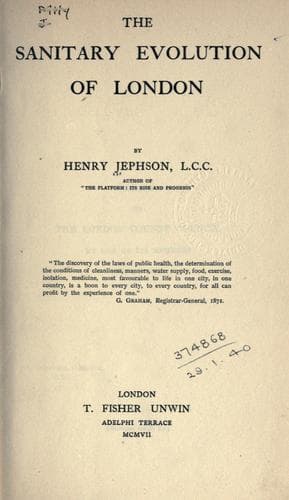
The Sanitary Evolution of LondonJephson, Henry (Henry Lorenzo)
History
The Sanitary Evolution of London
Jephson, Henry (Henry Lorenzo)
Public health -- England -- London
Sometimes a sentence enables so much else to be understood. Thus, in
1892, a Medical Officer of Health wrote:--
"Many persons think the Public Health Act an innovation on their
privileges."
Describing the insanitary condition of 230 houses in Provost Street,
Shoreditch, the Sanitary Inspector wrote in 1892:--
"The difficulty of dealing with these houses has been greatly increased
by the circumstance that the leases will expire in a very few years.
There was, therefore, a very natural objection on the part of many of
the leaseholders to execute substantial works, of which the freeholder
would in a few years reap the benefit, and without contributing
anything to the expense of the improvements."
This "very natural objection" entailed, of necessity, sickness and
death upon a considerable number of persons.
The Vestry of St. Pancras wrote in 1893:--
"The primary cause of houses and buildings becoming insanitary is the
neglect of freeholders to compel lessees to comply with the terms
and conditions of their leases. If the Vestry were empowered (where
freeholders are negligent) to compel freeholders to cause lessees to
carry into effect the covenants of the leases, the houses inhabited by
the poorer classes would not become so wretchedly dilapidated and a
scandal, but might be maintained in a fairly habitable condition."
The Medical Officer of Health for Bethnal Green exonerated some
property owners, whilst fixing the blame on others.
"... As a rule it is the professional insanitary property owner who has
to be summoned time after time, and who exhausts every technicality and
raises every possible objection, well knowing that in the usual way
only an order costing some few shillings will be made against him."
Others, however, went further. The Medical Officer of Health for
Islington wrote in 1893:--
"Since 1891 there has been a steady forward movement, and ... one now
constantly hears of the persecution of the 'poor property owner.'
"That owner who for long years had everything his own way, and who did
as little as he could to make things healthy for his tenants, knowing
well that there were plenty of persons ready to occupy any or every
house. Property has rights, but so has flesh and blood; and if it be
right that property should be protected from unnecessary exactions, it
is surely righteous that the health and lives of human beings should be
safeguarded in every way."
And in the following year, writing about some insanitary bakehouses, he
said: "It has always seemed to me a very absurd argument that because a
place has been allowed to be occupied for a long series of years to the
detriment of the health of the people working therein that therefore it
must not be now abolished.
"If those insanitary places have been occupied for such a long time,
surely they have more than recouped their owners for the money that has
been originally spent on their erection?"
Public-domain text, read in full here on John Shaqi.
Reviews
Reviews
No reviews yet
Be the first to share your thoughts on this work.
Elsewhere in the archive
Join the Discussion
Join the discussion
Sign in to leave a comment or review.
Sign InorCreate an account