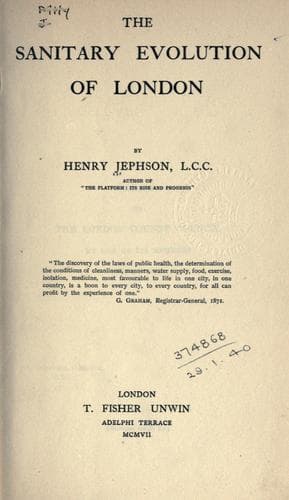
The Sanitary Evolution of LondonJephson, Henry (Henry Lorenzo)
History
The Sanitary Evolution of London
Jephson, Henry (Henry Lorenzo)
Public health -- England -- London
Almost uniformly, so far as they were concerned, it was found that
bye-laws as to houses let in lodgings were not enforced, and no, or
practically no inspection of workshops, of which there were thousands,
nor of "outworkers" had been carried out, and that the sanitary staff
was quite inadequate for the work.
Though much was thus most unsatisfactory, yet in many other important
matters which vitally affected the public health, considerable progress
was being made.
In the matter of water supply a steady but slow improvement had, under
public pressure, taken place. In 1892 a Royal Commission was appointed
to inquire as to whether the existing sources of supply were adequate,
and it reported in the following year.
"We are strongly of opinion," they said, "that the water as supplied
to the consumer in London is of a very high standard of excellence
and of purity, and that it is suitable in quality for all household
purposes. We are well aware that a certain prejudice exists against
the use of drinking water derived from the Thames and the Lea, because
these rivers are liable to pollution, however perfect the subsequent
purification by natural or artificial means may be; but having regard
to the experience of London during the last thirty years, and to the
evidence given us on the subject, we do not believe that any danger
exists of the spread of disease by the use of this water, provided that
there is adequate storage, and that the water is efficiently filtered
before delivery to the consumers."
This statement was to a certain extent satisfactory, but the fact
remained that both the Thames and Lea still received sewage effluents
above the intakes, and considerable pollution from other causes; and
that diseases might still be water-borne and water-distributed by them.
The thoroughness of the filtration also was often open to doubt.
Improvement was gradually being effected in the system of removal or
disposal of filth and refuse of all sorts and kinds; the sweepings of
the streets, the refuse from houses. According to the general practice
of the local authorities the great bulk of this stuff was first brought
to yards or places, the property of the authorities, and there sorted
or sifted and sent down the river or along the canals in barges, or
sometimes even by rail to the country. But the system was costly and
insanitary and inefficient, and as was pointed out--"it could not be
deemed satisfactory when large metropolitan districts inflict their
filth upon smaller communities in urban districts."
A system of destroying much of this filth by fire had been devised,
and gradually was adopted by the local authorities. It was found that
with a properly constructed and efficient destructor no nuisance need
result, and this method of disposing of house refuse was much more
desirable from a sanitary point of view than that usually adopted by
London Sanitary Authorities.
Public-domain text, read in full here on John Shaqi.
Reviews
Reviews
No reviews yet
Be the first to share your thoughts on this work.
Elsewhere in the archive
Join the Discussion
Join the discussion
Sign in to leave a comment or review.
Sign InorCreate an account