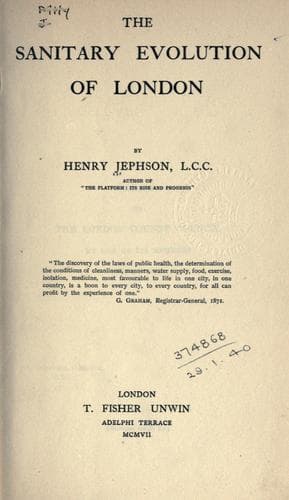
The Sanitary Evolution of LondonJephson, Henry (Henry Lorenzo)
History
The Sanitary Evolution of London
Jephson, Henry (Henry Lorenzo)
Public health -- England -- London
A certain number of local authorities adopted this method to the great
advantage of the community, and though there is still much to be done
in this direction, the change, so far as it has gone, has undoubtedly
minimised a great evil.
Both numerous and various are the measures which have to be taken for
the protection of the public from disease. One of the most essential
of these was disinfection--the disinfection of rooms where there
had been infectious or contagious disease, and the disinfection or
destruction of clothing or articles used by the person suffering from
the disease. The process of disinfection originally was of the most
primitive character and doubtful efficacy, but the progress of science
had elaborated really effective methods.
In 1866 the local authorities had been given power to provide a proper
place with all necessary apparatus, &c., for the disinfection of
infected clothing, &c., free of charge, and to give compensation for
articles destroyed. Thus every inducement was given to the public to
get infected articles disinfected. But many years were to pass before
provision by the Vestries was extensively made.
By the Public Health London Act, 1891, this provision was made
imperative on the local authorities.
Disinfection by steam was considered practically the only efficient
system. By 1895 twenty-four sanitary authorities had provided
themselves with this apparatus, six with an apparatus whereby
disinfection was effected by dry heat, and eight had arranged with a
contractor.
When it is a fact that a few infected rags could let loose disease of
the worst type upon a community, the advantages to the public of the
general practice of disinfection were incalculable. And in London the
advantages were specially great.
In almost every district hundreds of houses were disinfected every
year, and thousands--even tens of thousands--of articles.
The system of the compulsory notification of infectious diseases
facilitated greatly the work of disinfection, for by informing the
authorities where cases of such disease occurred it enabled them to
scotch disease in its breeding-places, and so it was of the greatest
benefit to the community. How great may be gathered from the following
figures.
The number of cases of Infectious Diseases in London notified under the
Act of 1889 were:--
29,795 in 1890
46,074 " 1892
67,485 " 1893
49,699 " 1896
42,344 " 1899
Of those in 1893:--
36,901 were cases of Scarlet Fever
3,633 " " Enteric "
22 " " Typhus
13,026 " " Diphtheria
2,813 " " Smallpox
Great work was being done in the prevention of the spread of infectious
disease in London by the Metropolitan Asylums Board, in whose hospitals
thousands of persons suffering from such disease were isolated.
Dr. G. Buchanan, Chief Medical Officer to the Local Government Board,
wrote in 1892:--
Public-domain text, read in full here on John Shaqi.
Reviews
Reviews
No reviews yet
Be the first to share your thoughts on this work.
Elsewhere in the archive
Join the Discussion
Join the discussion
Sign in to leave a comment or review.
Sign InorCreate an account