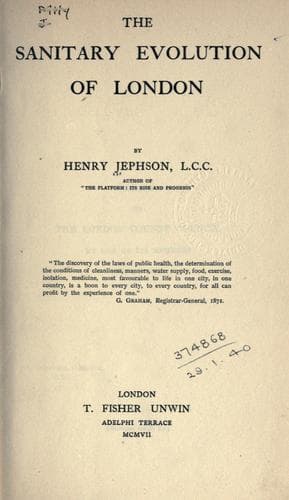
The Sanitary Evolution of LondonJephson, Henry (Henry Lorenzo)
History
The Sanitary Evolution of London
Jephson, Henry (Henry Lorenzo)
Public health -- England -- London
And, in addition to these institutions, there were Poor Law
dispensaries. The establishment of these dated from 1870, and by 1890
there were 44 of them. The immense amount of work they did is shown by
the following figures: "In 1890 nearly 120,000 orders were given to
Medical Officers for attendance on patients, 53,572 being seen at their
own homes, and 59,149 at the dispensaries. It is calculated that there
are about eight attendances on each order. Favourable opinions were
expressed as to the quality of the treatment afforded at them."
There is no means of even forming an estimate of the results of
these great remedial agencies, but that they were an immense advance
on previous arrangements for the treatment of the sick poor is a
well-established fact.
The Lords Select Committee reported that:--
"The evidence on the whole appears to indicate a general recognition
of the high standard of efficiency attained by the best of the new
infirmaries.
"The poor do not generally regard the infirmary as they do the
workhouse; they look upon it rather as a State-supported hospital; they
come to the infirmary, are cared for, cured, and go out again without
feeling that they are tainted with pauperism."
The other great factor in the sanitary evolution of London was the
group of great hospitals--general and special--supported, not by the
State nor by aid from the local rates, but by the charitable public,
and governed and managed and worked not by officials, paid either by
the central or local authorities, but by men--lay and medical--who,
from the highest and most public-spirited motives, devoted themselves
to this responsible work.
The general hospitals in 1890 numbered nineteen--some of them great
institutions, such as St. Bartholomew's, St. Thomas's, Guy's, the
London Hospital; and the number of special hospitals--many of them
small--was stated to be 67 in 1890.
"The total number of beds in the general and special hospitals in
London combined was stated by Dr. Steele to be 8,500, of which 6,500
are continually employed. But according to Mr. Burdett--8,094 and
6,143."
"The vast numbers of persons who are treated in out-patients'
departments of hospitals, the number treated at the eleven hospitals
with schools, were estimated by one witness at over half a million."
Here, again, no precise estimate can be formed of the part these great
institutions have taken in the sanitary evolution of London. That their
part has been a really great one is evident without figures--proved
not only by the millions restored to health and capable citizenship,
but even more by their adopting and reducing to practice, and placing
within the reach of the whole community, the vast benefits following
the great scientific discoveries of recent times.
Public-domain text, read in full here on John Shaqi.
Reviews
Reviews
No reviews yet
Be the first to share your thoughts on this work.
Elsewhere in the archive
Join the Discussion
Join the discussion
Sign in to leave a comment or review.
Sign InorCreate an account