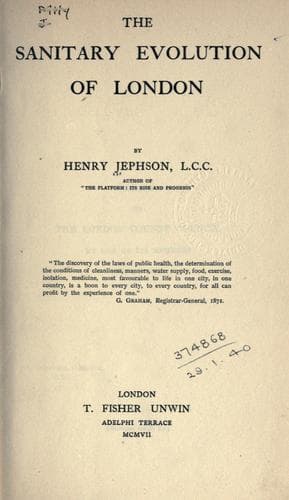
The Sanitary Evolution of LondonJephson, Henry (Henry Lorenzo)
History
The Sanitary Evolution of London
Jephson, Henry (Henry Lorenzo)
Public health -- England -- London
"Whilst, during the first twenty years of the Board's experience,
London was again and again visited with epidemics of smallpox, during
the past seven years it has, thanks to the action of the managers in
having removed to and isolated at Long Reach all cases of the disease,
been practically non-existent as a health disturbing factor.
"The percentage mortality of smallpox cases treated by the Board
decreased from 20·81 in 1871 to 4·0 in 1896, and the annual mortality
from 2·42 to practically zero."
The rate of death from diphtheria also showed a continuous fall, and
this fall had been coincident with the introduction and increasing use
of the anti-toxic serum treatment of the disease.
A valuable criticism on the existing machinery for the sanitary
government of London was given in a report of the Metropolitan Asylums
Board Statistical Committee in June, 1892:--
"Although London possesses an ambulance service and a system of
hospitals admittedly unrivalled, yet it has no central authority
charged with the duties of tracing out an outbreak of this infectious
disease (smallpox), and of taking concerted action towards stamping it
out by measures of disinfection and vaccination and re-vaccination.
"These matters still remain in the hands partly of the 41 local
sanitary authorities, partly of the Local Government Board, and partly
of the London County Council.
"Clearly the present arrangements are not only cumbrous and incapable
of that rapid action essential to success in dealing with infectious
disease, but they are also excessively expensive."
In connection with hospital accommodation there were two other factors
in the sanitary evolution of London. One of these was the provision
made by the Poor Law for the treatment and care of the sick poor.[182]
Previous to 1867 the accommodation provided by the Poor Law for the
sick was in the sick wards of the workhouses. The Act of that year,
which had established the Metropolitan Asylums Board, laid the basis
for the removal to separate hospitals of paupers suffering from the
worst forms of infectious disease. The same Act authorised the building
and establishment of Poor Law infirmaries, thus removing most of the
sick from the workhouse wards, giving them better treatment and better
prospect of recovery.
In 1892 the number of new infirmaries was 24, containing 12,445 beds;
but a large proportion of the sick were still kept in the workhouses,
the returns for 1890 showing about 4,000 occupied beds in them.
Public-domain text, read in full here on John Shaqi.
Reviews
Reviews
No reviews yet
Be the first to share your thoughts on this work.
Elsewhere in the archive
Join the Discussion
Join the discussion
Sign in to leave a comment or review.
Sign InorCreate an account