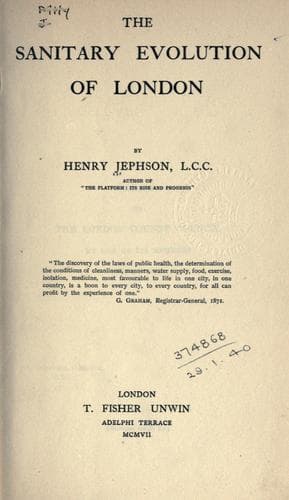
The Sanitary Evolution of LondonJephson, Henry (Henry Lorenzo)
History
The Sanitary Evolution of London
Jephson, Henry (Henry Lorenzo)
Public health -- England -- London
That drink and insanitary housing constitute a vicious circle should by
no means deter the most vigorous efforts being continued to improve the
conditions of housing and to raise the standard of the public health.
There was widespread testimony through the latter half of the decade
that the public health in London was improving. Thus the Medical
Officer of Health for the Bow District in Poplar wrote in 1895: "We
have only to remember what London used to be, and consolation can be
found in the comparison. Epidemics are not so frequent, disease is
not so virulent, and those attacked stand greater chances of recovery
through better and more skilful treatment."
And the Medical Officer of Health for Paddington in 1896: "There
has been a steady diminution in water-borne disease since
efficiently-filtered Thames water has been substituted for the numerous
wells and pumps of former days."
The Medical Officer of Health for the Strand reported in 1897: "The
Strand District (as to health) compares favourably with other years.
The result of your labours is a steady improvement in the health of the
inhabitants."
And the Medical Officer of Health for Islington in 1897 reported the
death-rate as 15·80--the lowest since registration was introduced in
1837.
In Whitechapel "the policy of your Board has resulted in a considerable
saving of human life." The death-rate for the district in 1879 was 26·0
per 1,000, and in 1899 it was 19·3 per 1,000.
In Battersea the death-rate was 26·8 in 1871, and 17·6 in 1901.
But infantile mortality did not show a similar rate of improvement.
In many parishes there was a decided improvement. In many, however,
infantile mortality remained at a very high rate.
In Bethnal Green, in 1893, nearly half the total deaths were of
children under five years of age--a figure which drew from the Medical
Officer of Health the remark: "The ignorance of women of the working
classes on the subject of infant feeding is colossal." In 1896 it was
51·5 per cent., and in 1898 it was 49·7 per cent.
In Poplar the Medical Officer of Health wrote, in 1895: "I think it my
duty to point out the terribly high rate of infant mortality...."
In Of 1,000 Births in 1895 Died under 1 Year.
Bow 179
Shoreditch 199
St. George's-in-the-East 196
Limehouse 202
"It is an awful state of affairs that so many young children die every
year."
In Shoreditch, in 1896, 49·1 per cent. of the total deaths were of
children under five; in Islington, in 1896, 42·4 per cent.; in Hackney,
in 1898, 40·9 per cent.; in Fulham, in 1896, 51 per cent.
On the south side of the river--in St. George-the-Martyr, in 1894, it
was 58 per cent. of the total deaths; in St. Olave, Southwark, 48·6 per
cent. in 1896.
Public-domain text, read in full here on John Shaqi.
Reviews
Reviews
No reviews yet
Be the first to share your thoughts on this work.
Elsewhere in the archive
Join the Discussion
Join the discussion
Sign in to leave a comment or review.
Sign InorCreate an account