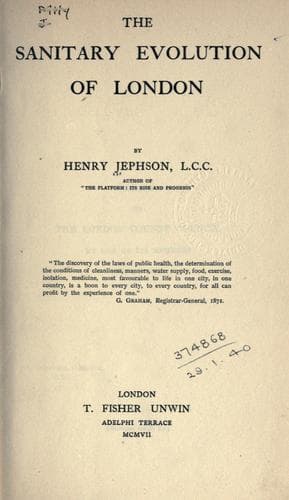
The Sanitary Evolution of LondonJephson, Henry (Henry Lorenzo)
History
The Sanitary Evolution of London
Jephson, Henry (Henry Lorenzo)
Public health -- England -- London
A most hopeful sign was the greater public interest taken in matters
pertaining to the public health.
The Medical Officer of Health for Islington wrote in 1892:--
"With the advance of education the public and Parliament appreciate the
importance of more and more safeguarding the public health."
In 1895:--
"They (middle class) will not tolerate the sanitation of a few years
ago; indeed, they expect that the houses they live in will at least
be rendered safe against the entrance of sewer gas, and themselves
safeguarded against infectious disease."
And the Medical Officer of Health for the "City" in 1894:--
"Attention has been more particularly directed to premises and
dwellings of the better class, the occupants of which are becoming more
and more exacting owing to the increased knowledge acquired by the
public on all sanitary questions. Some of these premises are of great
size and employ many hundreds of persons, and many enormous insurance,
banking, and gigantic commercial establishments."
And that there is a community of interest in a healthy London was
becoming more widely realised. That the fact should have taken so long
to be grasped is extraordinary as it was so manifest a one. Over and
over again it had been proved that disease was not restrained by the
paper boundaries of parishes, and that once set alight anywhere no
limit could be put to its widespread devastations. An unhealthy area in
any part of the metropolis constituted a danger to the whole. Nor was
disease a respecter of classes. All were interested in keeping it away.
And, after many painful lessons, people were realising much more than
formerly that disease was a most costly infliction. The Medical Officer
of Health for St. James', Westminster, in his report for 1893, set out
the business aspect of it:--
"The position of St. James', as the shopping centre for the best
retail trade of the West-end of London, makes the district more and
more a city of luxurious shops, hotels, clubs, and lodging-houses.
Increasing facilities for travel to the suburbs, and the increasing
value of premises, necessitate its utilisation for business purposes
during the day, and its comparative desertion at night.... Its resident
population of 25,000 persons is therefore an inadequate exponent of the
activity of its daily life, of the importance of its retail trade, and
of the necessity for active sanitation. An outbreak of smallpox or of
cholera would at once so damage the trade of the district as to inflict
upon its ratepayers a thousand times the cost which is now incurred
by their preventive sanitary service, and by the prompt removal of
infectious cases to suburban hospitals as is now done."
But that was only a single and a limited case.
Public-domain text, read in full here on John Shaqi.
Reviews
Reviews
No reviews yet
Be the first to share your thoughts on this work.
Elsewhere in the archive
Join the Discussion
Join the discussion
Sign in to leave a comment or review.
Sign InorCreate an account