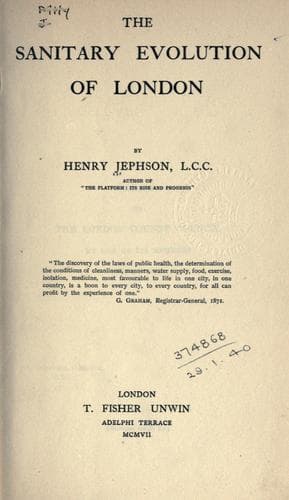
The Sanitary Evolution of LondonJephson, Henry (Henry Lorenzo)
History
The Sanitary Evolution of London
Jephson, Henry (Henry Lorenzo)
Public health -- England -- London
The industrial classes realised to a greater extent than ever before
the disastrous results to themselves and their families of sickness and
ill-health; the prolonged suffering, the loss of work and wages, the
ensuing hardships. And it was upon them more than on others that the
effects of disease fell most heavily.
In most matters the interests of the various parts of London, and of
the various classes, are one and the same, but in none to anything like
the same extent as in the vital matter of public health. Here they are
one and indivisible.
But neither Parliament nor the Government had got so far as to
recognise that yet, and London--the great metropolis--with its
four-and-a-half millions of people, was left for its protection against
disease to a number of semi-independent local sanitary authorities who
had no authority beyond their own area, and who could take no action
for the safety of London as a whole.
One thing was absolutely certain--and that was that the civic life
of London had within the decade been lifted to altogether a higher
plane. The publicity of the proceedings of the central representative
authority--whether of its meetings in the Council Chamber, or of
its constant applications to Parliament for legislation embodying
far-reaching civic reforms in London--the triennial elections, when
the area of discussion was shifted from the Council Chamber to the
constituencies, quickened the interest and awoke the dormant masses of
the people to the importance of civic administration and of civic laws.
In this remarkable change the subject of the public health strode to
the front. Men began to realise how it entered into every branch or
part of their own lives and of their families, how its ramifications
invaded every part of their existence, how much their welfare and
comfort and even their existence depended upon it. And the people had
a great load lifted off them--the load of despair begotten by the
hopelessness of any amelioration of the conditions of life which so
long had weighed them down. They felt now that there was some one to
whom they could complain, some public authority who would see that
things would be righted, if they could be righted, and hope was born in
their lives.
In 1899 another change was made in the system of local government in
London.
The Act of 1888, while dealing with the central government of London,
had practically not touched the local areas. The work was felt to be
incomplete, and in 1893 Commissioners were appointed "to consider the
proper conditions under which the amalgamation of the City and the
County of London can be effected, and to make specific and practical
proposals for that purpose."
They reported in August, 1894. Their general conclusion was contained
in the following paragraph.[183]
Public-domain text, read in full here on John Shaqi.
Reviews
Reviews
No reviews yet
Be the first to share your thoughts on this work.
Elsewhere in the archive
Join the Discussion
Join the discussion
Sign in to leave a comment or review.
Sign InorCreate an account