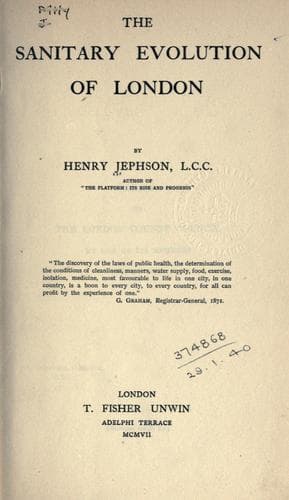
The Sanitary Evolution of LondonJephson, Henry (Henry Lorenzo)
History
The Sanitary Evolution of London
Jephson, Henry (Henry Lorenzo)
Public health -- England -- London
[182] See the Report of Select Committee of House of Lords on
Hospitals, P.P. 1892, vol. xiii.
[183] See Report of Royal Commissioners on the Amalgamation of the City
and County of London, 1894.
[184] See Hansard, 1899, vol. lxvii. p. 354.
[185] In his last report he recorded the death of J. Munro, who had
been Inspector of Nuisances for thirty-three years, so for that long
period they had worked together.
CHAPTER VII
1901-1906
ONCE more the census placed on record the actual population of the
great metropolis, no longer divided, so far as local government
was concerned, into parishes and districts, but now into a smaller
number of municipal boroughs. The figures of this census are the last
available for reliable deductions as to numerous important matters
forming part of that comprehensive subject, the sanitary evolution of
London.
The enumerated population of London had reached the great number of
4,536,541, and showed an increase of 308,224 during the ten years 1891
to 1901. The rate of increase, however, continued to show a decline,
having fallen from 10·4 to 7·3 per cent. during the intercensal period.
The same movement of the population noted in previous censuses was
recorded in this one.
In the City of London and six of the central metropolitan boroughs the
enumerated population showed an actual decline of over 67,000 in the
ten years, notwithstanding that the recorded excess of births over
deaths in that period amounted approximately to 70,000.
In all the other boroughs there had been increases. In the Eastern
group the increases had been very small, with the exception of Stepney,
where, owing to the immigration of aliens, the population had increased
13,484. In the Northern group the greatest increase had been in Hackney
(19,666). In the Western group Fulham showed the highest increase,
namely, 45,500; whilst on the south side of the river, Wandsworth had
increased 76,500, and several others showed large increases.
Outside the boundaries of the county the "outer ring" had attained to a
population of 2,044,553 persons--an increase of 639,000.
If the metropolis and this "outer ring" were regarded as one city--and
in many matters it is hard to consider them apart--the total population
in 1901 was 6,581,372.
The information as to the birthplaces of the people showed that of the
4,536,541 persons, 3,016,580 were natives of London. The proportion
of natives of London had increased; the proportion from the rest of
the United Kingdom had decreased; whilst there had been an increase of
40,000 foreigners, the number having considerably more than doubled
since 1881. Of every 1,000 inhabitants, 668 were born in London, and
332 elsewhere, as against 653 and 347 respectively in 1891.
Public-domain text, read in full here on John Shaqi.
Reviews
Reviews
No reviews yet
Be the first to share your thoughts on this work.
Elsewhere in the archive
Join the Discussion
Join the discussion
Sign in to leave a comment or review.
Sign InorCreate an account