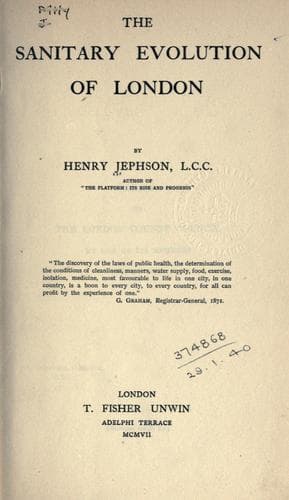
The Sanitary Evolution of LondonJephson, Henry (Henry Lorenzo)
History
The Sanitary Evolution of London
Jephson, Henry (Henry Lorenzo)
Public health -- England -- London
Once again the arrivals and departures by the gates of life and death
were recorded. In the ten years from the 1st of April, 1891, to the
31st of March, 1901, 1,329,428 births had been registered, and 838,454
deaths. The excess of births over deaths, therefore, was 490,974; and
as the increase of population was 309,228, it followed that 181,746
persons had migrated. As the migration had only been 114,000 in 1891,
it was manifest that migration to outside the County of London was
increasing.
The total number of inhabited houses was 571,768, as against 547,146
in 1891; but owing to a variation in the manner of collecting the
information, the figures have little value for comparative purposes.
The accurate figures given of the population of London enabled the
death-rate to be calculated on facts instead of upon estimates.
The death-rate was 17·1 per 1,000 living in 1901, a decrease from 18·6
in the previous year, and from 21·0 in 1891.
But to be set against this was the portentous fact that the birth-rate
had declined from 31·8 per 1,000 in 1891 to 29·0 per 1,000 persons
living in 1901, the lowest recorded in London since civil registration
began.
The public health of London was now altogether on a better level than
it had been before, but in the course of the year 1901 some cases
of smallpox appeared in various parts of London, and in 1902 there
was the most severe outbreak of it--with the possible exception of
1884-5--since 1871, nearly 9,000 cases being admitted to the hospitals
of the Metropolitan Asylums Board between September, 1901, and July,
1902. Ninety-three patients were removed to hospital in one day, and
on one day (March 11th) 1,604 cases were under treatment. Over 1,300
persons died of it in the year.
The cost of disease to the community has often been referred to in
previous chapters. The Metropolitan Asylums Board stated that so far as
it was concerned, the cost for 1901-2 might be put at £500,000--equal
to about a threepenny rate--a sum which was wholly apart from loss of
wages to the individual, and various other expenses, and apart from the
charge upon the rates of those who were pauperised by the death of the
breadwinner of the family.
1903 was "a year of comparatively very slight prevalence of infectious
disorders."
In 1904 there was "a marked absence of undue activity amongst the
infectious diseases of the metropolis."
And 1905 was the healthiest year in the records of London since
registration, the death-rate being 15·1 per 1,000.
In the five years which have passed since the census of 1901,
Parliament has passed three Acts of the utmost consequence to the
sanitary condition of the people of London, marking, in their
respective spheres, definite stages in the sanitary evolution of the
metropolis.
The sanitary evils to which many of the people were subject might, as
has already been stated, be roughly divided into two classes--those of
their dwellings at night, and those of their workplaces in the day.
Public-domain text, read in full here on John Shaqi.
Reviews
Reviews
No reviews yet
Be the first to share your thoughts on this work.
Elsewhere in the archive
Join the Discussion
Join the discussion
Sign in to leave a comment or review.
Sign InorCreate an account